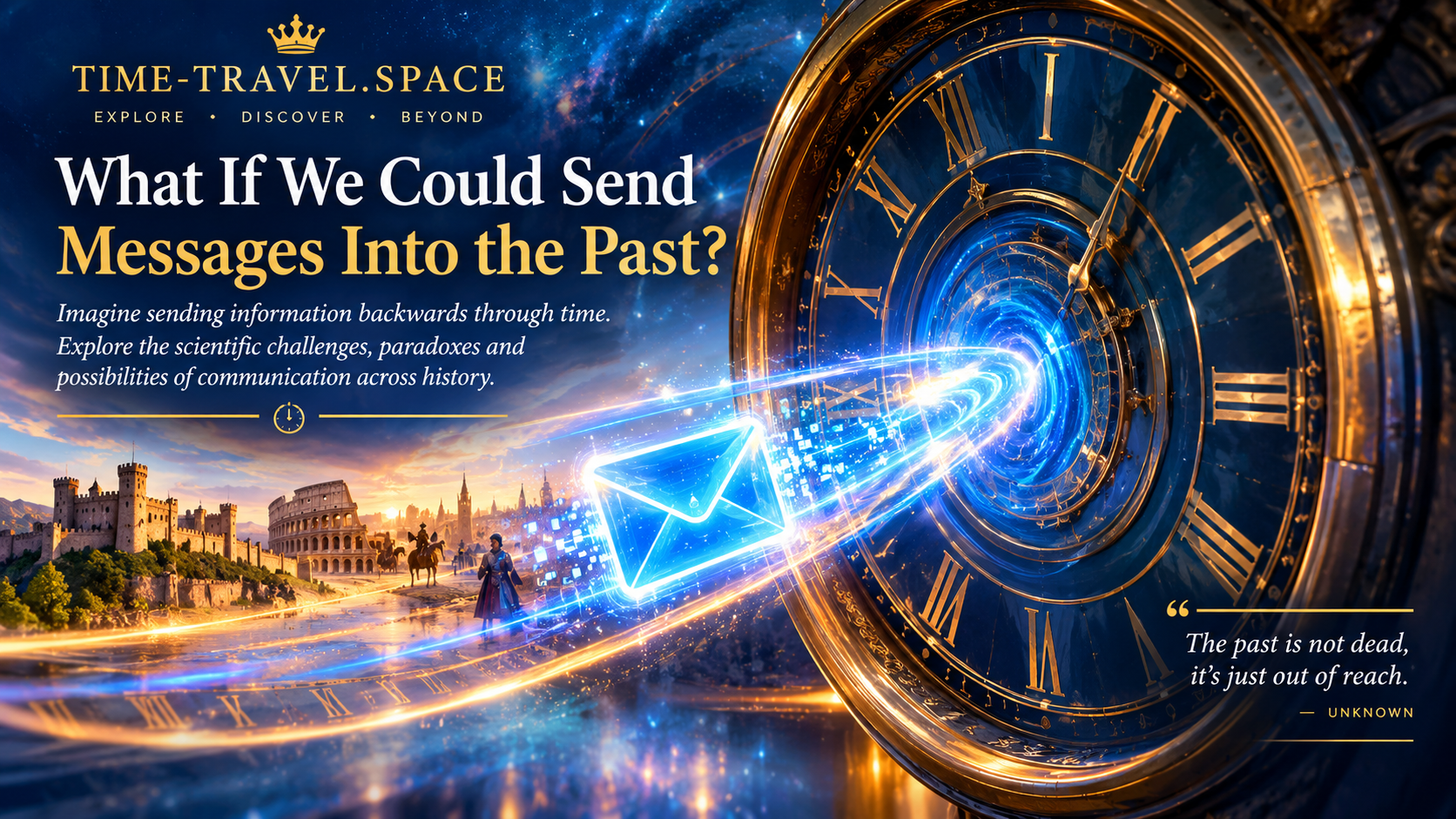
Imagine sending information backwards through time. Explore the scientific challenges, paradoxes and possibilities of communication across history.
Imagine waking tomorrow to find a message on your phone that was sent yesterday—by your future self. It says: “Do not take the 8:15 train.” Would you believe it? And if you obeyed, what would happen to the future in which you sent the warning?
The idea of communicating with the past sits at the crossroads of physics and science fiction. A message seems far simpler than transporting a person through time: it might require only a few bits of information, a receiver and a way to make the signal travel against the ordinary direction of cause and effect. Yet that final requirement is the extraordinary obstacle.
Could physics allow a message to travel backwards?
In everyday life, causes come before their effects. Modern physics complicates our intuition about time, but it has not demonstrated a practical method for sending a controllable message into the past.
Einstein’s theory of general relativity describes gravity as the curvature of spacetime. Some mathematical solutions to its equations contain unusual structures—such as closed timelike curves—that could, in principle, loop through spacetime. These are intriguing theoretical possibilities, not proven time machines. Whether such structures can exist in our universe, remain stable and be used by people is unknown.
The central puzzle is not simply how to send a signal, but how to make its arrival consistent with everything that already happened.
This is an original editorial summary, not a quotation attributed to a named scientist.
Quantum entanglement: a shortcut to yesterday?
Quantum entanglement links measurement outcomes of particles in ways that have no straightforward classical explanation. It is sometimes portrayed in popular culture as instant communication. However, entanglement alone cannot be used to transmit a chosen message faster than light, let alone backwards in time. The outcomes cannot be controlled to spell out a signal at the other end.
Quantum theory contains thought experiments and interpretations that explore time symmetry, but none has established a reliable method for sending information into the past. The distinction between a fascinating mathematical idea and a working communication device is essential.
The paradox problem
Suppose a researcher sends a message to prevent the experiment that will eventually allow the message to be sent. If the experiment never happens, who sent the warning?
The consistency approach: events involving the message would have to fit together without contradiction. The warning might already be part of the history it appears to change.
The branching-timeline approach: a message could affect a different branch of events rather than rewrite the sender’s own past. This is a popular science-fiction idea, not an established communication technology.
The chronology-protection possibility: unknown physical effects might prevent usable backward time travel altogether. This remains an open theoretical question.
A thought experiment: the message in the archive
Imagine a historian discovers a sealed envelope dated 100 years in the future. Inside is a precise description of an event that has not yet happened. If the historian publishes it, does the message help cause the event—or merely record a future that was always going to unfold?
This is the storytelling power of temporal communication: one small note can turn knowledge into a cause, and a cause into a puzzle.
What could we do with messages from the future?
If safe, reliable communication with the past were ever possible, its implications would be enormous. Warnings about disasters, scientific discoveries delivered decades early, or personal messages to loved ones could reshape decisions and history. It could also create new risks: financial manipulation, political interference, and uncertainty about whether any decision was truly our own.
Even a one-way message would raise difficult questions. Who gets to send it? Can the information be trusted? Would changing one event erase the circumstances that produced the warning? A technology capable of crossing time would need rules as carefully designed as the device itself.
What science says today
At present, there is no verified technology for sending messages into the past. Relativity and quantum physics provide deep insights into time, causality and information, but they do not give us a practical past-directed messaging system. For now, the idea belongs to theoretical debate and imaginative fiction.
That does not make the question pointless. Exploring it helps clarify what causality means, why information matters and where our current understanding of the universe reaches its limits.
If you could send just one sentence to the past, what would you say—and would you dare to read the reply?
Beyond the stars, could another version of reality exist?
Imagine standing on the Long Walk in Windsor, looking towards the Castle as the evening sky turns gold. Now imagine another Windsor beyond the stars: the same river, the same towers, but with a different history. In that imagined world, perhaps a different decision changed the course of a life—or history took an entirely different turn.
The idea of parallel universes sits at the fascinating intersection of physics, philosophy and science fiction. Scientists have explored several ideas that are sometimes grouped under the word multiverse, but they do not all mean the same thing, and none has established that a second version of our world is real.
What is a parallel universe?
In everyday language, a parallel universe is a hypothetical reality that exists alongside our own. It might be imagined as a universe with different events, different physical conditions or another version of history. In cosmology, “multiverse” is a broad label for proposals involving more than one universe; the details depend on the particular hypothesis.
Some proposals suggest regions of space so distant that light from them could never reach us. Other ideas arise from interpretations of quantum mechanics. These are distinct scientific concepts, not evidence for a doorway through which a person could step into another reality.
The many-worlds interpretation
One influential interpretation of quantum mechanics is known as the many-worlds interpretation, associated with physicist Hugh Everett’s work in the 1950s. In broad terms, it describes quantum outcomes as part of a universal quantum state rather than treating measurement as a single, special collapse. Its implications are subtle and remain debated among physicists and philosophers.
It is important not to confuse this interpretation with the familiar film or television image of a person walking through a portal into a world where their life unfolded differently. The many-worlds interpretation does not provide a known method for visiting, communicating with or checking on another branch.
“Some multiverse hypotheses may therefore be great fun to think about but not practically falsifiable and therefore have no predictive scientific value.” — NASA Astronomy Picture of the Day, “Multiverses: Do Other Universes Exist?”
This quotation captures the key caution: a compelling possibility is not automatically a confirmed discovery. Scientific proposals need to be assessed by their mathematics, consistency and, where possible, observable consequences.
Could another universe contain another Earth?
Science fiction often imagines a neighbouring Earth with familiar people and places but a different past. It is a powerful storytelling device: what if a historic decision had gone another way, or a chance meeting had never happened? Such scenarios invite us to think about probability, identity and the consequences of our choices.
However, there is currently no verified evidence that an alternate Earth containing copies of people we know exists. Nor is there an established experiment that can reveal what those hypothetical people might be doing. The idea belongs in the realm of speculation unless and until testable evidence changes that position.
How could scientists investigate the multiverse?
Researchers can examine whether particular multiverse proposals follow from broader theories and whether those theories make predictions that could be tested. In cosmology, scientists study the cosmic microwave background, the expansion of the Universe and the large-scale distribution of galaxies. Such observations help test models of our Universe, but they have not confirmed the existence of parallel universes.
A major challenge is that some hypothetical universes might be causally disconnected from ours. If no signal can travel between them and no observable trace is left in our own universe, direct testing may be impossible. This makes it especially important to distinguish a mathematically developed idea from an experimentally confirmed fact.
Parallel universes in films, books and television
Alternate realities are a rich source of drama because they turn abstract questions into personal stories. A familiar street can become strange; a hero can meet a version of themselves; a single altered event can reshape an entire society. These stories can introduce audiences to genuine questions in physics, even when their portals, timelines and universe-hopping machines are fictional inventions.
When watching a parallel-universe story, try asking: is it using the multiverse as a scientific hypothesis, a metaphor for regret, or simply an imaginative adventure? Knowing the difference can make the story more enjoyable without blurring the line between evidence and invention.
Could Windsor have a parallel history?
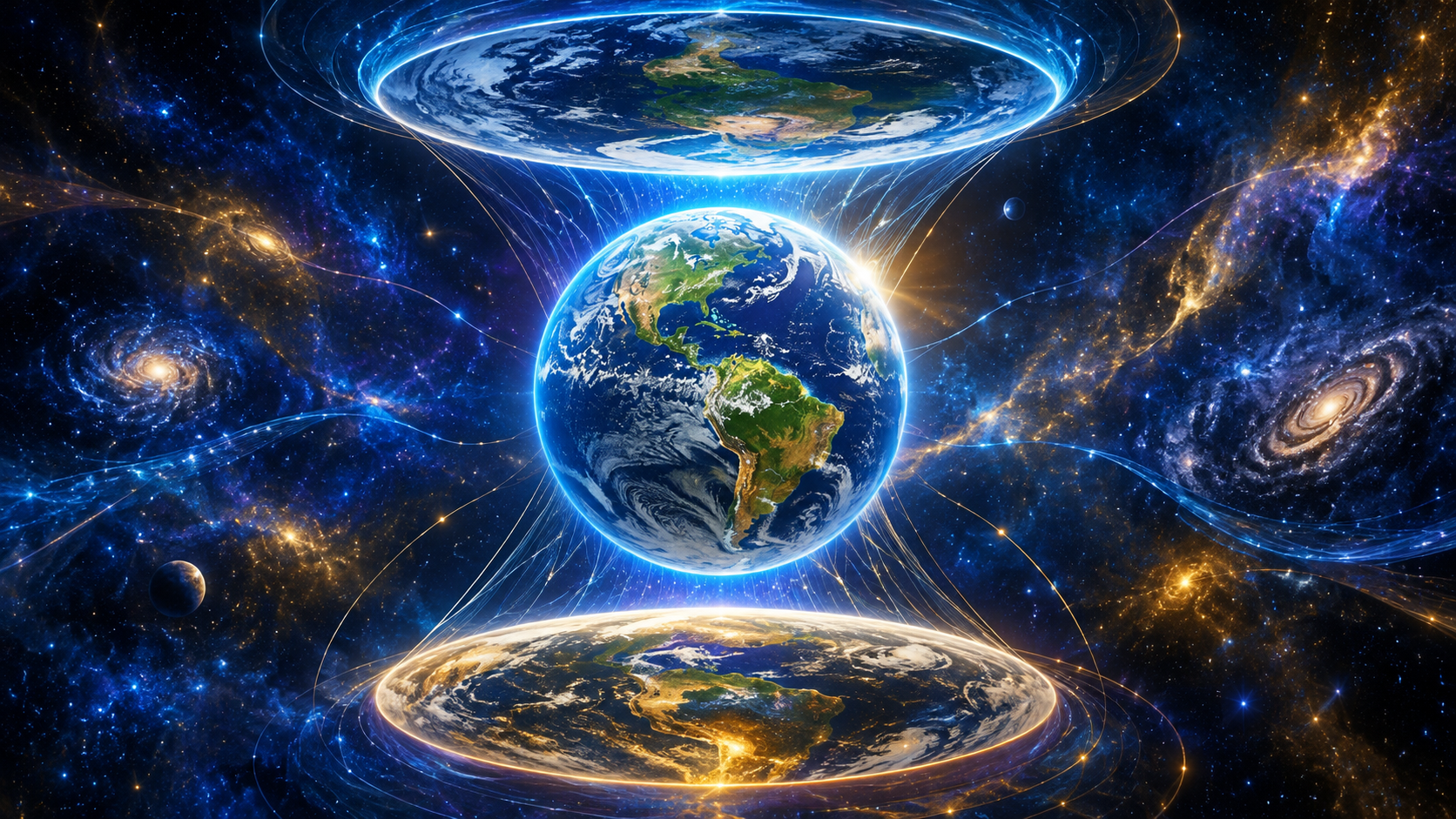
Picture a royal castle beneath two skies: one illuminated by a setting sun, the other by distant galaxies. In a fictional parallel Windsor, a different monarch might have commissioned a different tower, a bridge might never have been built, or the town might have developed along another route. These are creative possibilities, not claims about real history.
Windsor’s actual history is extraordinary enough to explore on its own. A parallel-world thought experiment simply gives us another way to appreciate how places change over time—and how small decisions can inspire big questions about the past and the future.
The big question: is another reality out there?
The honest answer is that we do not know. Parallel universes appear in serious scientific discussions and in imaginative fiction, but the different ideas must be judged individually. At present, there is no confirmed proof that another universe contains a duplicate of Earth or that people can travel between realities.
That uncertainty is part of the appeal. The multiverse invites us to ask what reality means, what science can test and where imagination begins. For now, the most responsible conclusion is also the most intriguing: the idea remains open to investigation, but it is not an established fact.
Editorial note: This article is an introduction for general readers. It distinguishes established science from hypotheses and fictional examples; it does not claim that parallel universes have been observed.
Discover the real-life locations behind British cinema, Hammer Horror, Harry Potter, James Bond and some of television’s best-loved productions.
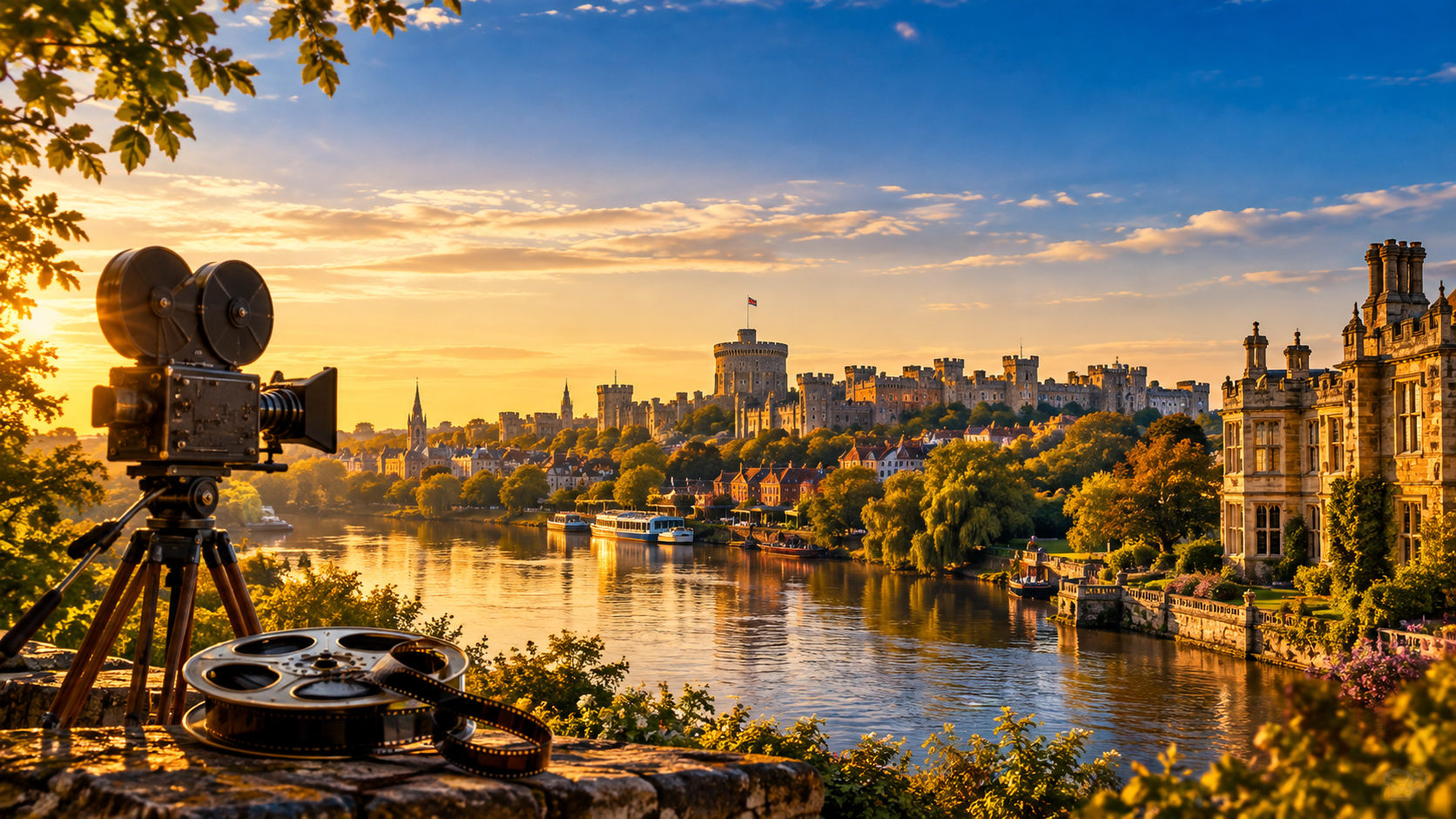
Windsor is famous around the world for its historic castle, royal traditions and beautiful countryside. Yet the surrounding area has another fascinating story to tell: it has provided the backdrop for films, television dramas, comedies and fantasy adventures enjoyed by audiences across the globe.
From the atmospheric buildings of Bray to the sweeping landscapes of Windsor Great Park, the Royal Borough of Windsor and Maidenhead offers film enthusiasts plenty to discover.
Whether you love classic British cinema, supernatural adventures, period dramas or modern blockbusters, you may be surprised by how many familiar productions have connections with this part of Berkshire.
1. Bray Film Studios: A home of British horror
One of the most important names in the area’s film history is Bray Film Studios, situated between Windsor and Maidenhead.
The studios became closely associated with Hammer Film Productions, the British company famous for its gothic horror films. Productions featuring legendary performers Christopher Lee and Peter Cushing helped establish Hammer’s distinctive style, combining atmospheric country houses, dramatic lighting, elaborate make-up and memorable monsters.
Among the celebrated productions associated with Bray are The Curse of Frankenstein (1957), Dracula (1958) and The Mummy (1959).
Bray’s film-making heritage extends beyond horror. The studios were also involved in the production of Alien (1979), the science-fiction classic directed by Ridley Scott, and The Rocky Horror Picture Show (1975) has an important connection to the local film-making story.
For film historians, Bray illustrates how a location can become part of cinema history through the creative work of directors, actors, designers, technicians and special-effects artists.
2. Oakley Court and the gothic look of British cinema
Near Bray stands Oakley Court, a striking Victorian Gothic building overlooking the Thames.
Its distinctive architecture has made it an enduring part of the area’s screen heritage. The building’s dramatic exterior, elaborate stonework and unusual atmosphere made it particularly suitable for productions requiring a mysterious mansion or a grand, slightly unsettling setting.
Oakley Court is famously associated with The Rocky Horror Picture Show (1975), whose extraordinary blend of musical comedy, science fiction and gothic imagery has attracted generations of fans.
The building is also connected with the wider Hammer horror tradition, including The Curse of Frankenstein (1957).
These locations demonstrate why filmmakers are attracted to historic British buildings: they can create a convincing atmosphere without relying entirely on constructed sets or computer-generated imagery.
Before visiting, check the venue’s current access arrangements. A film location may be privately owned or operating as a hotel rather than a public attraction.
3. Windsor Great Park: Countryside on the big screen
Windsor Great Park offers a very different cinematic landscape.
Its avenues, woodland, open countryside and expansive views can represent a variety of places on screen. The official Visit Windsor film-location guide lists numerous productions associated with the park, including Harry Potter, Robin Hood, Bridget Jones’s Baby, Snow White and the Huntsman and No Time to Die.
The park’s versatility helps explain its appeal. One landscape might become an enchanted forest in a fantasy film, a secluded country road in a thriller or a romantic setting in a period drama.
For visitors, the pleasure lies in appreciating the scenery while learning how filmmakers transform real locations into fictional worlds.
Visitor tip: Windsor Great Park is extensive, so plan your route before setting out. Check the relevant access information and remember that a location appearing in a film does not necessarily mean that the exact filming spot is accessible to the public.
4. Harry Potter and the magic of British locations
The Harry Potter films helped introduce a new generation of viewers to Britain’s historic buildings and dramatic landscapes.
The Windsor area has a connection with the wider filming story through locations associated with the films, including Windsor Great Park. The Royal Borough’s official guide lists the Harry Potter films among productions filmed in the area.
It is worth remembering that a film’s fictional Hogwarts School is not one single real building. The filmmakers used a combination of locations, sets, visual effects and other production techniques to create its magical world.
That combination is part of what makes location research so interesting: the finished scene may bring together several different places to create one convincing setting.
For fans, a day exploring the Windsor area can therefore become an opportunity to appreciate both the real landscape and the imagination that transforms it on screen.
5. James Bond: British landscapes and international adventures
The James Bond films are renowned for their spectacular locations, from international cities to elegant country estates and dramatic countryside.
The Royal Borough’s official film-location guide lists A View to a Kill (1985) in connection with Ascot Racecourse and No Time to Die (2021) among productions associated with Windsor Great Park.
These connections highlight the importance of British locations to international cinema. Familiar landscapes can be presented in a completely new way through camera angles, lighting, editing and the movement of actors and vehicles.
For Bond fans, discovering a filming location adds another dimension to watching a favourite film. A landscape that lasts only a few seconds on screen may have a much longer story in real life.
6. Period dramas, historic houses and royal Britain
Historic buildings around Windsor have also helped bring earlier centuries to life.
The official Visit Windsor guide records productions associated with locations such as Cliveden, Dorney Court and Eton College. The titles listed include Elizabeth (1998), The Other Boleyn Girl (2008), The Social Network (2010) and Bridgerton.
Each production presents different challenges. A historical drama might require an authentic-looking exterior, while a modern story might use the same type of building to represent wealth, education or social status.
Filmmakers may also change the appearance of a location through carefully selected props, costumes, lighting and set decoration.
The result is a reminder that architecture is more than a background: it can help communicate the period, atmosphere and social world of a story.
7. How a real location becomes a film set
What happens when a film crew arrives at a historic property or a public landscape?
The process can involve location managers, directors, cinematographers, production designers, lighting teams, sound technicians, costume departments and many other specialists.
Before filming begins, a production generally needs to assess practical matters such as access, transport, electricity, parking, safety and the protection of the site.
The crew then works to capture the required scenes while respecting any conditions attached to filming permission.
Historic locations can be especially demanding because their owners and managers must balance the needs of a production with the preservation of the building and the experience of visitors.
In Windsor, filming on public streets, in the park and at heritage sites may involve different permissions. The Royal Borough provides official guidance for productions seeking to film locally.
If you want to explore the area’s screen heritage, consider making a day of it.
Start with Windsor and Eton, where historic streets and riverside views provide a wonderful introduction to the area. Continue towards Bray to learn about the history of British horror cinema, and investigate the locations around the Royal Borough that appear in the official film guide.
If you have more time, consider a visit to Windsor Great Park, checking access and travel arrangements beforehand.
Some filming locations are privately owned, and others may be visible only from public viewpoints. Do not enter private property or restricted filming areas without permission.
You can use the official location guide to identify places associated with productions that interest you, then plan a route that suits your available time.
9. Why Windsor’s film heritage matters
Film and television help people see familiar places in new ways. A country house becomes a haunted mansion, a woodland path becomes a fantasy landscape, and an English country estate becomes part of an international adventure.
For Windsor, this screen heritage complements the area’s better-known royal history. It offers another reason to explore the surrounding countryside, discover historic buildings and appreciate the creative industries that bring stories to life.
It also provides opportunities for future articles on WindsorCastle.info, including interviews with local historians, film-location guides, classic cinema features and quizzes about famous productions.
Test your film knowledge
Question 1: Which British production company became famous for gothic horror films associated with Bray?
Question 2: Which science-fiction film directed by Ridley Scott is part of Bray Studios’ history?
Question 3: Name one film associated with Windsor Great Park in the official Visit Windsor guide.
Question 4: Which 1975 musical comedy is famously associated with Oakley Court?
Question 5: Why do filmmakers use real historic buildings and landscapes?
Answers: 1. Hammer Film Productions. 2. Alien. 3. Examples include Harry Potter, No Time to Die or Bridget Jones’s Baby. 4. The Rocky Horror Picture Show. 5. To provide authentic architecture, atmosphere and scenery for their stories.
Discover more with WindsorCastle.info
The next time you watch a British film or television drama, look beyond the actors and the story. You may discover that the setting has a history of its own.
Explore Windsor’s royal heritage, enjoy its historic streets and countryside, and discover the films that have helped bring this remarkable part of England to the screen.
Article prepared for WindsorCastle.info. Film titles and location associations are provided for educational and tourism purposes. All film titles, production names and related trademarks remain the property of their respective owners.
Could another Earth exist beyond our own? Explore the science, the many-worlds interpretation, the limits of current evidence and the appeal of parallel universes in fiction.
Windsor is famous around the world for its historic castle, royal traditions and beautiful countryside. Yet the surrounding area has another fascinating story to tell: it has provided the backdrop for films, television dramas, comedies and fantasy adventures enjoyed by audiences across the globe.
Enjoy the WindsorCastle.info ScreenSaver, a relaxing visual experience for your computer, tablet or mobile device. Designed for visitors and fans of Windsor, this screen saver provides a dedicated display experience that you can open directly through your web browser.
An original Star Wars-inspired space adventure linking Windsor Castle with a mysterious starship, courage, friendship and hope. Includes an original story, featured image, image credit and related Windsor stories.
Enjoy the WindsorCastle.info ScreenSaver, a relaxing visual experience for your computer, tablet or mobile device. Designed for visitors and fans of Windsor, this screen saver provides a dedicated display experience that you can open directly through your web browser.
Visit WindsorCastle.info to explore royal history, Windsor Castle, local attractions and other interesting content about Windsor and the British royal heritage.
Open the ScreenSaver page, view it on your device and enjoy a simple browser-based experience. For the best results, use a modern browser and adjust your screen settings to suit your display.
Could another Earth exist beyond our own? Explore the science, the many-worlds interpretation, the limits of current evidence and the appeal of parallel universes in fiction.
Windsor is famous around the world for its historic castle, royal traditions and beautiful countryside. Yet the surrounding area has another fascinating story to tell: it has provided the backdrop for films, television dramas, comedies and fantasy adventures enjoyed by audiences across the globe.
Enjoy the WindsorCastle.info ScreenSaver, a relaxing visual experience for your computer, tablet or mobile device. Designed for visitors and fans of Windsor, this screen saver provides a dedicated display experience that you can open directly through your web browser.
An original Star Wars-inspired space adventure linking Windsor Castle with a mysterious starship, courage, friendship and hope. Includes an original story, featured image, image credit and related Windsor stories.
Featured image: Windsor Castle beneath the evening sky. Photo by Toa Heftiba via Unsplash. Image credit and source recorded in the WordPress media library.
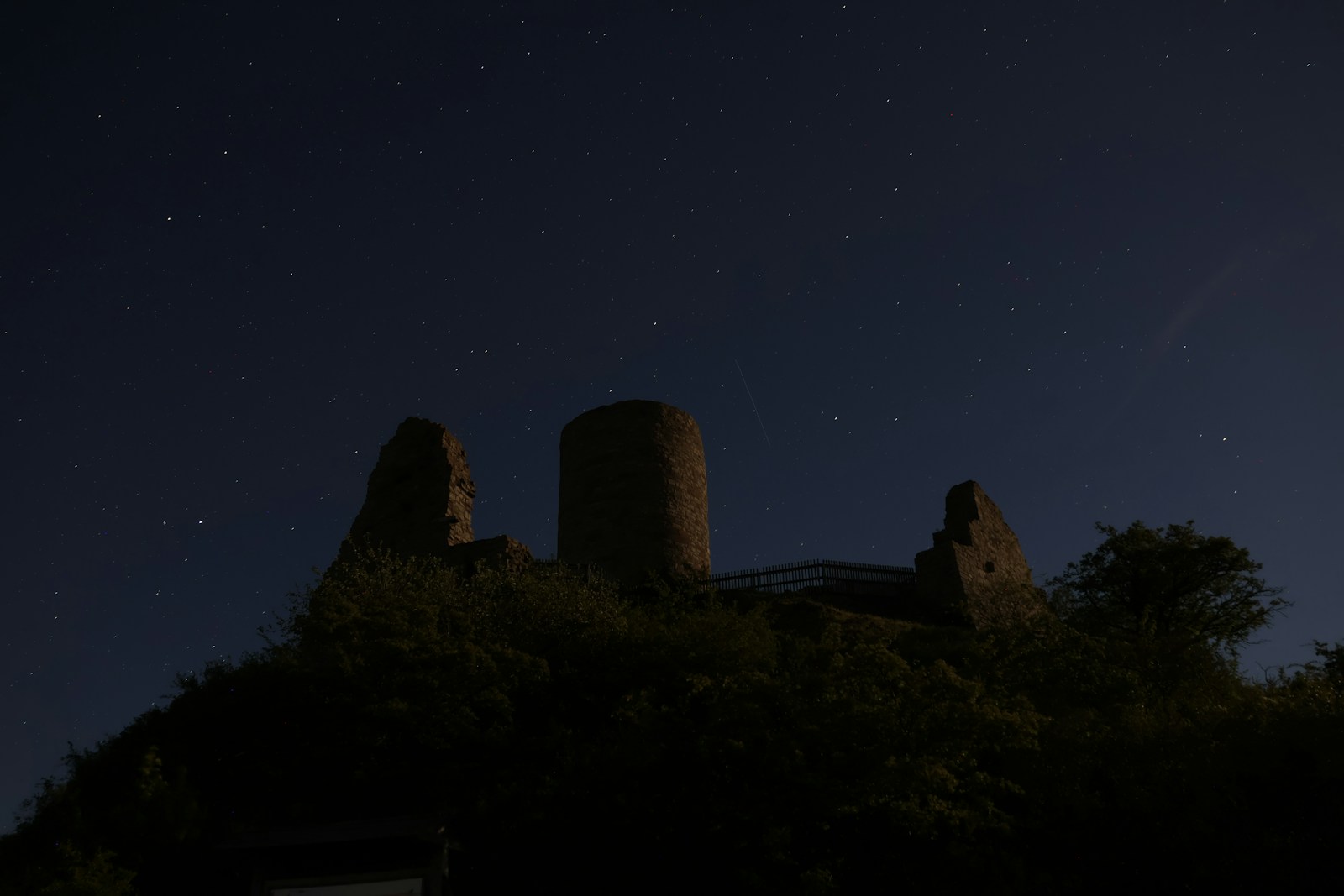
What if a galaxy far, far away had a quiet connection to an ancient royal castle? On a moonlit evening, beneath the stars above Windsor, a young traveller named Rowan looked across the Long Walk and noticed a strange blue light moving silently through the sky.
The Visitor from the Stars
The light descended beyond the trees and revealed a small, battered starship. Its pilot was a mysterious traveller called Aster, carrying an old navigation crystal that had begun to glow whenever it pointed towards Windsor.
“Some places are remembered by history,” Aster said. “Others are remembered by the stars.”
Rowan followed Aster through the quiet grounds, where the ancient stones seemed almost to whisper stories of kings, queens, knights and long-forgotten journeys. Aster explained that the crystal was not a weapon. It was a map—a map showing worlds connected by courage, friendship and hope.
A Secret Beneath the Castle
Deep beneath the castle, they discovered an old chamber. At its centre stood a circular table covered with symbols that looked strangely like constellations. When Rowan placed the crystal on the table, the chamber filled with tiny points of light.
One light represented Earth. Another represented a distant world beyond the stars. Between them appeared a shining path.
But the path was fading.
The Choice
Aster told Rowan that the crystal could open the route home, but only if someone stayed behind to guide it. Rowan faced a difficult choice: return safely or help a stranger reach home.
Remembering the stories of brave people who had protected Windsor through the centuries, Rowan chose to help.
Together they activated the crystal. A brilliant beam rose above the castle, turning the night sky silver and blue. The starship lifted silently into the darkness.
“May the stars remember Windsor,” Aster called as the ship disappeared.
A New Legend
The following morning, everything looked normal. Visitors walked through Windsor, birds crossed the sky, and the castle stood proudly above the town.
Only Rowan knew what had happened.
And high above the Earth, a tiny starship carried a new entry in its navigation records:
“Windsor — a place where courage can be found beneath the stars.”
For Star Wars Fans
This is an original, unofficial fan-style story inspired by the adventurous spirit of space opera. It is not an official Star Wars story and is not affiliated with or endorsed by Lucasfilm or Disney.
Google and Meta are racing to build AI agents that can do more than answer questions. Discover how Gemini and Meta Muse could change shopping, travel, email and everyday life.
Aston Villa end Manchester City’s perfect start, Arsenal keep pace and Tottenham win the derby. Read Saturday’s Premier League round-up and our predictions for Sunday 25 October’s five fixtures.
Plan a festive visit with our Windsor events calendar for November and December 2026, including Christmas at Windsor Castle, Windsor Great Park Illuminated, the Christmas Fair, Carols on the Hill and Theatre Royal Windsor’s pantomime. Check official dates, ticket prices, opening times and booking links before travelling.
Ten @PremierLeague @fixtures, three headline clashes & a provisional #Christmas table forecast. Explore our tactical previews of #Aston Villa v #Manchester City, #Chelsea v #Tottenham and #Liverpool v #Brighton, plus illustrative treble odds and #score #predictions. #Manchester City face a demanding trip to #Aston Villa, Chelsea prepare for a London derby against #Tottenham, and #Liverpool…
Discover nearly 1,000 years of Windsor Castle history, from William the Conqueror and medieval kings to royal ceremonies, St George’s Chapel and the great fire of 1992.
Bayern Munich host Arsenal in a heavyweight Champions League clash on 21 October 2026. Read the tactical preview, team news, win-draw-away probabilities and an illustrative Bukayo Saka movement graphic.
We use cookies to improve your experience on our site. You can choose to accept all cookies, allow only necessary cookies, or reject non-essential cookies.
Contains information related to marketing campaigns of the user. These are shared with Google AdWords / Google Ads when the Google Ads and Google Analytics accounts are linked together.
90 days
__utma
ID used to identify users and sessions
2 years after last activity
__utmt
Used to monitor number of Google Analytics server requests
10 minutes
__utmb
Used to distinguish new sessions and visits. This cookie is set when the GA.js javascript library is loaded and there is no existing __utmb cookie. The cookie is updated every time data is sent to the Google Analytics server.
30 minutes after last activity
__utmc
Used only with old Urchin versions of Google Analytics and not with GA.js. Was used to distinguish between new sessions and visits at the end of a session.
End of session (browser)
__utmz
Contains information about the traffic source or campaign that directed user to the website. The cookie is set when the GA.js javascript is loaded and updated when data is sent to the Google Anaytics server
6 months after last activity
__utmv
Contains custom information set by the web developer via the _setCustomVar method in Google Analytics. This cookie is updated every time new data is sent to the Google Analytics server.
2 years after last activity
__utmx
Used to determine whether a user is included in an A / B or Multivariate test.
18 months
_ga
ID used to identify users
2 years
_gali
Used by Google Analytics to determine which links on a page are being clicked
30 seconds
_ga_
ID used to identify users
2 years
_gid
ID used to identify users for 24 hours after last activity
24 hours
_gat
Used to monitor number of Google Analytics server requests when using Google Tag Manager
1 minute
SourceBuster is used by WooCommerce for order attribution based on user source.
Name
Description
Duration
quads_browser_width
motexxt
Session
sbjs_session
The number of page views in this session and the current page path
30 minutes
sbjs_udata
Information about the visitor’s user agent, such as IP, the browser, and the device type
session
sbjs_first
Traffic origin information for the visitor’s first visit to your store (only applicable if the visitor returns before the session expires)
session
sbjs_current
Traffic origin information for the visitor’s current visit to your store
session
sbjs_first_add
Timestamp, referring URL, and entry page for your visitor’s first visit to your store (only applicable if the visitor returns before the session expires)
session
sbjs_current_add
Timestamp, referring URL, and entry page for your visitor’s current visit to your store
session
sbjs_migrations
Technical data to help with migrations between different versions of the tracking feature
session
Contirbution , and content for watching ads
cookie not savged
email address is required to send word document after contribution to read content