Time Travel · Science & Imagination
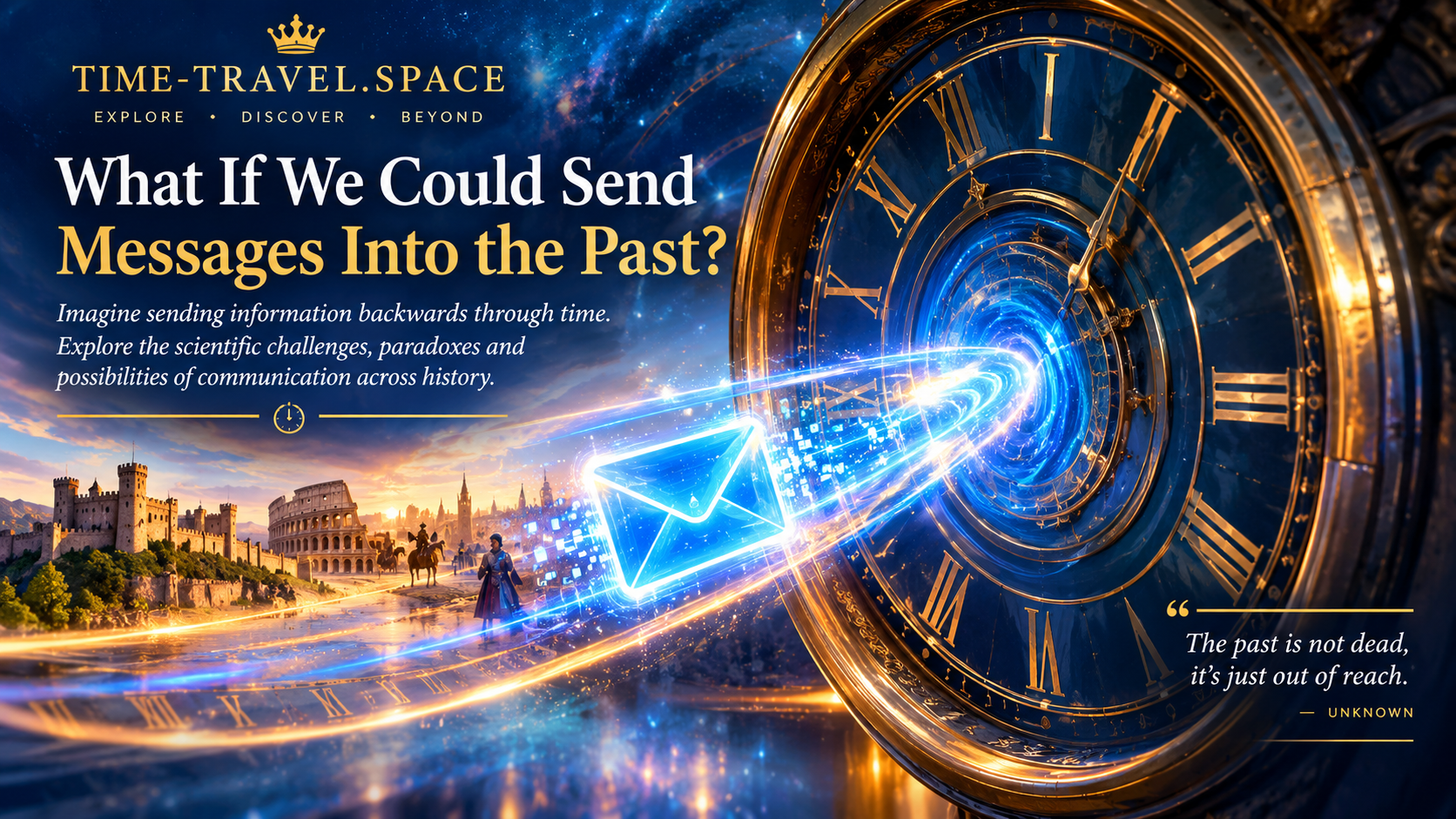
What If We Could Send Messages Into the Past?
Imagine sending information backwards through time. Explore the scientific challenges, paradoxes and possibilities of communication across history.
Imagine waking tomorrow to find a message on your phone that was sent yesterday—by your future self. It says: “Do not take the 8:15 train.” Would you believe it? And if you obeyed, what would happen to the future in which you sent the warning?
The idea of communicating with the past sits at the crossroads of physics and science fiction. A message seems far simpler than transporting a person through time: it might require only a few bits of information, a receiver and a way to make the signal travel against the ordinary direction of cause and effect. Yet that final requirement is the extraordinary obstacle.
Could physics allow a message to travel backwards?
In everyday life, causes come before their effects. Modern physics complicates our intuition about time, but it has not demonstrated a practical method for sending a controllable message into the past.
Einstein’s theory of general relativity describes gravity as the curvature of spacetime. Some mathematical solutions to its equations contain unusual structures—such as closed timelike curves—that could, in principle, loop through spacetime. These are intriguing theoretical possibilities, not proven time machines. Whether such structures can exist in our universe, remain stable and be used by people is unknown.
The central puzzle is not simply how to send a signal, but how to make its arrival consistent with everything that already happened.
This is an original editorial summary, not a quotation attributed to a named scientist.
Quantum entanglement: a shortcut to yesterday?
Quantum entanglement links measurement outcomes of particles in ways that have no straightforward classical explanation. It is sometimes portrayed in popular culture as instant communication. However, entanglement alone cannot be used to transmit a chosen message faster than light, let alone backwards in time. The outcomes cannot be controlled to spell out a signal at the other end.
Quantum theory contains thought experiments and interpretations that explore time symmetry, but none has established a reliable method for sending information into the past. The distinction between a fascinating mathematical idea and a working communication device is essential.
The paradox problem
Suppose a researcher sends a message to prevent the experiment that will eventually allow the message to be sent. If the experiment never happens, who sent the warning?
- The consistency approach: events involving the message would have to fit together without contradiction. The warning might already be part of the history it appears to change.
- The branching-timeline approach: a message could affect a different branch of events rather than rewrite the sender’s own past. This is a popular science-fiction idea, not an established communication technology.
- The chronology-protection possibility: unknown physical effects might prevent usable backward time travel altogether. This remains an open theoretical question.
A thought experiment: the message in the archive
Imagine a historian discovers a sealed envelope dated 100 years in the future. Inside is a precise description of an event that has not yet happened. If the historian publishes it, does the message help cause the event—or merely record a future that was always going to unfold?
This is the storytelling power of temporal communication: one small note can turn knowledge into a cause, and a cause into a puzzle.
What could we do with messages from the future?
If safe, reliable communication with the past were ever possible, its implications would be enormous. Warnings about disasters, scientific discoveries delivered decades early, or personal messages to loved ones could reshape decisions and history. It could also create new risks: financial manipulation, political interference, and uncertainty about whether any decision was truly our own.
Even a one-way message would raise difficult questions. Who gets to send it? Can the information be trusted? Would changing one event erase the circumstances that produced the warning? A technology capable of crossing time would need rules as carefully designed as the device itself.
What science says today
At present, there is no verified technology for sending messages into the past. Relativity and quantum physics provide deep insights into time, causality and information, but they do not give us a practical past-directed messaging system. For now, the idea belongs to theoretical debate and imaginative fiction.
That does not make the question pointless. Exploring it helps clarify what causality means, why information matters and where our current understanding of the universe reaches its limits.
If you could send just one sentence to the past, what would you say—and would you dare to read the reply?
Further reading
- Stanford Encyclopedia of Philosophy: Time Travel
- Nobel Prize: experiments with entangled photons and quantum information
- Einstein Online: causality and relativity
SEO keywords: message to the past, communication through time, time travel, temporal communication, time paradox, quantum entanglement, causality.