
Tag: Prediction

  • Defensive Players Focus: Premier League Defending & Fantasy Football Points

    Defensive Players Focus: Premier League Defending & Fantasy Football Points

    Football pitch viewed from above, illustrating defensive shape, positioning and team organisation
    Defensive organisation begins with shape, communication and smart positioning. Photograph: Bence Balla-Schottner / Unsplash.

    Football analysis for WindsorCastle.info | Updated 16 October 2026

    Goals win headlines, but organised defending wins points. The best defensive players do far more than slide into tackles: they read danger early, protect space, communicate with teammates and help their side regain possession. In this edition of Defensive Players Focus, we look at the statistics that matter, the different jobs defenders perform and how to judge a performance fairly.

    The key question: Is a defender simply making lots of emergency interventions, or are they preventing dangerous situations from developing in the first place?

    1. The defensive statistics worth watching

    No single statistic can describe a complete defensive performance. Tackles and clearances show activity, while interceptions, blocks, aerial duels and errors provide different clues about how a player protects their goal.

    • Tackles won: challenges that successfully regain possession or force play out under the relevant data provider’s definition.
    • Interceptions: reading an opponent’s pass and moving into its path.
    • Clearances: removing the ball from a dangerous area, even if the team cannot keep possession.
    • Blocks: stopping a shot or, in some datasets, cutting out a pass. Check the provider’s definition.
    • Aerial duels: contests for balls played through the air. Winning the duel is important, but the next action matters too.
    • Errors leading to shots or goals: costly mistakes, best assessed alongside the player’s overall workload and role.
    • Clean sheets and goals conceded: team outcomes, not individual ratings. Defending is a collective responsibility.

    The Premier League’s official statistics guide lists defensive categories including tackles, tackle success, blocks, interceptions, clearances, aerial battles won and errors. Definitions can vary between providers, so comparisons should use consistent data.

    2. Centre-backs: command the danger zone

    Centre-backs must judge when to step forward and challenge, when to hold the line and when to cover a teammate. Strong positional awareness can prevent a through-ball reaching a striker; good communication can keep the defensive line organised against runners.

    When assessing a centre-back, look beyond the clearance count. Consider whether they track runners, win important aerial contests, defend one-on-one situations, protect the space in front of goal and pass accurately when building from the back.

    3. Full-backs and wing-backs: defend wide areas

    Full-backs face quick wingers, overlapping runners and crosses into the penalty area. They need timing and balance: dive into a challenge too early and an attacker may go past; retreat too far and the opponent can deliver a dangerous cross.

    Modern full-backs also contribute to attacks. A useful assessment therefore considers recovery runs, one-on-one defending, interceptions, support for the centre-backs and the space left behind when they advance.

    4. Defensive midfielders: stop attacks before they reach the back four

    A defensive midfielder can protect the defence by screening passing lanes, tracking runners and collecting second balls. Interceptions and recoveries can be particularly revealing, but a player who positions themselves well may prevent an opponent attempting a pass at all.

    Watch the player’s starting position when the opposition has possession. Are they blocking the route into the striker? Can they press without leaving a gap behind? Do they win the ball and help their team keep it?

    5. Goalkeepers are part of the defensive unit

    Saves matter, but goalkeeper analysis should also include positioning, handling, command of crosses, communication and distribution. A goalkeeper who claims a cross cleanly may prevent a shot from happening; a keeper who passes well can help the team escape pressure.

    Save totals need context. A goalkeeper facing many difficult shots may record more saves than one whose defence limits opponents to low-quality attempts. Where available, compare shot-stopping figures with the quality and location of shots faced.

    6. How to compare players fairly

    Raw totals can favour players who have played more minutes or whose teams spend longer defending. For a fairer comparison:

    1. Check appearances and minutes played.
    2. Compare rates per 90 minutes when the data provider offers them.
    3. Separate centre-backs, full-backs and defensive midfielders where possible.
    4. Consider the team’s possession and tactical approach: a side that defends deep may record more clearances.
    5. Look at several matches rather than judging a player from one game.
    6. Combine statistics with match footage and role-specific context.

    Remember: More tackles do not automatically mean better defending. A player may make many tackles because opponents repeatedly attack their area; another may prevent danger through anticipation and positioning.

    7. A simple defensive performance scorecard

    Use this checklist when watching a match. It is a viewing aid, not an official rating system.

    Area What to look for Question to ask
    Positioning Spacing, covering and tracking runners Did the player close dangerous space?
    Duels Ground challenges and aerial contests Were important duels won cleanly?
    Awareness Interceptions and scanning Did they read danger early?
    Protection Blocks, clearances and recovery runs Were high-quality chances prevented?
    Distribution Passing choices after winning the ball Could the team keep possession or start a counter-attack?
    Discipline Fouls, cards and risky challenges Did the player defend effectively without unnecessary fouls?

    8. The players and numbers to follow this season

    For current Premier League rankings, consult the official statistics pages before naming leaders or publishing totals. Rankings change after every round, and minimum minutes played can affect who qualifies for a leaderboard. The linked sources below provide ways to check defensive data without relying on outdated tables.

    Rather than declaring one player the league’s best defender from a single metric, compare a shortlist across tackles, interceptions, blocks, clearances, aerial duels and team performance. Explain the date and provider for every statistical snapshot.

    Conclusion: defending is an art as well as a statistic

    The finest defenders combine concentration, courage, timing and decision-making. A spectacular last-ditch tackle may save a match, but the quieter action that prevents the pass or closes the space can be just as valuable. The strongest analysis brings together statistics, tactical responsibility and what actually happened on the pitch.

    WindsorCastle.info • Fantasy Football Spotlight

    Who is scoring the most FPL points — and why?

    A dated snapshot after Gameweek 6 of the 2026/27 season, checked on 16 October 2026. Points change after every match, so check the official FPL site for the latest totals.

    Season leaders after six Gameweeks: Brighton’s Maxim De Cuyper and Pascal Groß were joint top on 53 points. Erling Haaland and João Pedro led forwards on 45, while Manchester City’s Rayan Cherki had 44. These are season totals, not points from one match.

    Leading Fantasy performers

    Player FPL points Why they are scoring well
    Maxim De Cuyper
    Brighton • Defender
    53 His advanced role gives him attacking chances despite his Fantasy defender classification. Three double-figure hauls in six Gameweeks point to goals, assists and potential clean-sheet returns combined.
    Pascal Groß
    Brighton • Midfielder
    53 Three goals and four assists, plus responsibility for corners, free-kicks and penalties. Dead-ball duties give him several ways to create points without needing to score every week.
    Erling Haaland
    Manchester City • Forward
    45 Six league goals and repeated high-quality chances are a strong goal-scoring signal. His points rely mainly on finishing and attacking returns rather than defensive actions.
    João Pedro
    Chelsea • Forward
    45 Five league goals and three assists in the snapshot. Goals and creative link-up play both contribute, although minutes and fitness should be checked before selecting him.
    Rayan Cherki
    Manchester City • Midfielder
    44 Four goals and two assists. He offers both finishing and chance creation; possible rotation and playing time remain important considerations.

    Snapshot source: Premier League Fantasy Scout coverage published 15 October 2026. Totals are historical, not a prediction of future points.

    What actually earns the points?

    Goals and assists

    Forwards earn most of their returns through goals, assists and bonus points. Compare goals with expected goals (xG), shots in the box and big chances to see whether a player repeatedly gets into scoring positions.

    Defensive returns

    Defenders can gain points from clean sheets, goals, assists and qualifying defensive contributions under the current FPL rules. De Cuyper is notable because his attacking role adds upside to his defender classification.

    Set pieces

    Corner and free-kick takers can create assists or score directly; penalty takers have a valuable extra route to goals. Groß’s set-piece role is an important part of his appeal. Duties can change, so verify current takers.

    Speed, finishing and defensive ability

    Ability What to compare What it tells us
    Speed and movement Sprints, runs behind defenders, touches in the box and minutes Pace can create separation, but only becomes Fantasy value when it leads to chances, returns or useful defensive recovery.
    Finishing Goals, shots in the box, big chances, xG and conversion Haaland’s goals and volume of chances indicate a strong scoring threat. A short scoring streak alone is less informative than repeated good chances.
    Creativity Assists, chances created, expected assists (xA), crosses and dead balls Groß and Cherki can return through the final pass as well as goals; chances still depend on teammates finishing.
    Defensive reliability Clean sheets, blocks, interceptions, clearances, aerial duels and team xGA Judge role and team context, not just tackle totals. A defender making many clearances may be busy because their team is under pressure.
    Penalties and corners Confirmed takers, set-piece delivery and direct free-kicks Dead-ball responsibility can lift a player’s potential but is not guaranteed to produce a goal or assist.

    Were they playing easy teams?

    Fixture difficulty can help explain a haul, but it should not be the only explanation. Manchester City’s home fixture against promoted Ipswich was considered favourable by the Fantasy Scout, which supported interest in Haaland and Cherki. Brighton’s leading pair also had multiple strong returns, so their totals should not be attributed to one easy opponent alone.

    For a fair test, compare opponents’ goals conceded, shots allowed in the box, clean sheets and expected goals against (xGA), while also checking home or away status, injuries, rotation and minutes played. A promoted team is not automatically easy to defend against or score against; use current performance rather than reputation.

    Pascal Groß — interview excerpt:

    “… play active, that we defend active.”

    Why it matters: Defensive work is collective. Pressing and controlling space can stop attacks before a defender needs a last-ditch tackle. See the linked Brighton interview for context.

    Erling Haaland — post-match comment:

    “It was a lovely moment that will stay with us a long time.”

    Fantasy lesson: A memorable result is not itself a forecast. Look at minutes, shot quality and repeatable chances before deciding whether to transfer a player in.

    Gameweek checklist for Fantasy managers

    • Check official FPL points after each Gameweek; this table is a dated snapshot.
    • Compare goals with xG and assists with xA, plus shots in the box and big chances.
    • For defenders, check clean-sheet prospects, defensive role and team xGA.
    • Confirm who takes penalties, corners and free-kicks.
    • Check minutes, injuries, rotation and the next three to five fixtures.
    • Do not assume a favourable fixture guarantees points.

    Editorial note: Statistics change during the season. Player quotations are short excerpts and should be read in the context of their original interviews. This is football analysis, not betting advice.

    Sources for Fantasy points, fixtures and quotes

    Sources and further reading

    Editorial note: Statistics and rankings are time-sensitive. Verify current figures and the relevant season before publication. This article is football analysis, not betting advice.

    In soccer (football), executing a legal tackle—particularly inside the penalty box—requires precise timing, body positioning, and cleanly winning the ball without making excessive or dangerous contact with the opponent.

    Key Elements of a Legal Tackle and Movement:

    1. Clean Contact with the Ball: The defender must make contact with the ball first. Making primary contact with the opponent’s legs or body before touching the ball is considered a foul, which inside the penalty box results in a penalty kick.
    2. Attacker Movement: The attacking player typically tries to shield the ball using their body or burst past the defender with a sudden change of pace or direction. Their movement dictates whether the defender has a clean window to challenge.
    3. Defender Footwork & Timing: A defender must judge the attacker’s momentum and timing. Instead of lunging blindly, effective defenders stay on their feet as long as possible, matching the attacker stride-for-stride, and only commit to a sliding or standing tackle when the ball is exposed and within reach.

    2026 Technology (3) Agentic AI (1) AI (5) Artificial Intelligence (3) Blog (101) British Royal Family (2) Castle (109) Changing of the Guard (2) Data Centres (1) dea (82) drink (94) England (5) food (92) football (7) Future (2) Future Technology (3) Investing (1) medication (92) Orbital Data Centres (1) Prediction (3) Premier League 26/27 (5) royal landmarks UK (2) Satellites (1) Science Fiction (2) soccer (5) Space Computing (1) Space Technology (1) SPCX (1) Starmind (1) Starship (1) Technology (2) Thca (2) visiting windsor castle (3) Windsor (103) Windsor 2026 (2) Windsor castle blog (110) Windsor Castle walk (2) Windsor Drinks (102) Windsor Great Park (2) Windsor hungry (97) Windsor Long Walk (3) Windsor tourism (3) Windsor travel blog (3) World Cup (3) World Cup 2026 (2)
  • Premier League Predictions: Expected Goals, Defensive Stars and Potential Upsets — Matchweek 7

    Premier League Predictions: Expected Goals, Defensive Stars and Potential Upsets — Matchweek 7

    Football pitch under stadium floodlights, illustrating Premier League expected-goals analysis and match predictions
    Football analytics: chance quality, defensive organisation and the fine margins behind a result. Image: Unsplash image source.

    Preview prepared 16 October 2026. Fixtures and team news can change; check official club updates before kick-off.

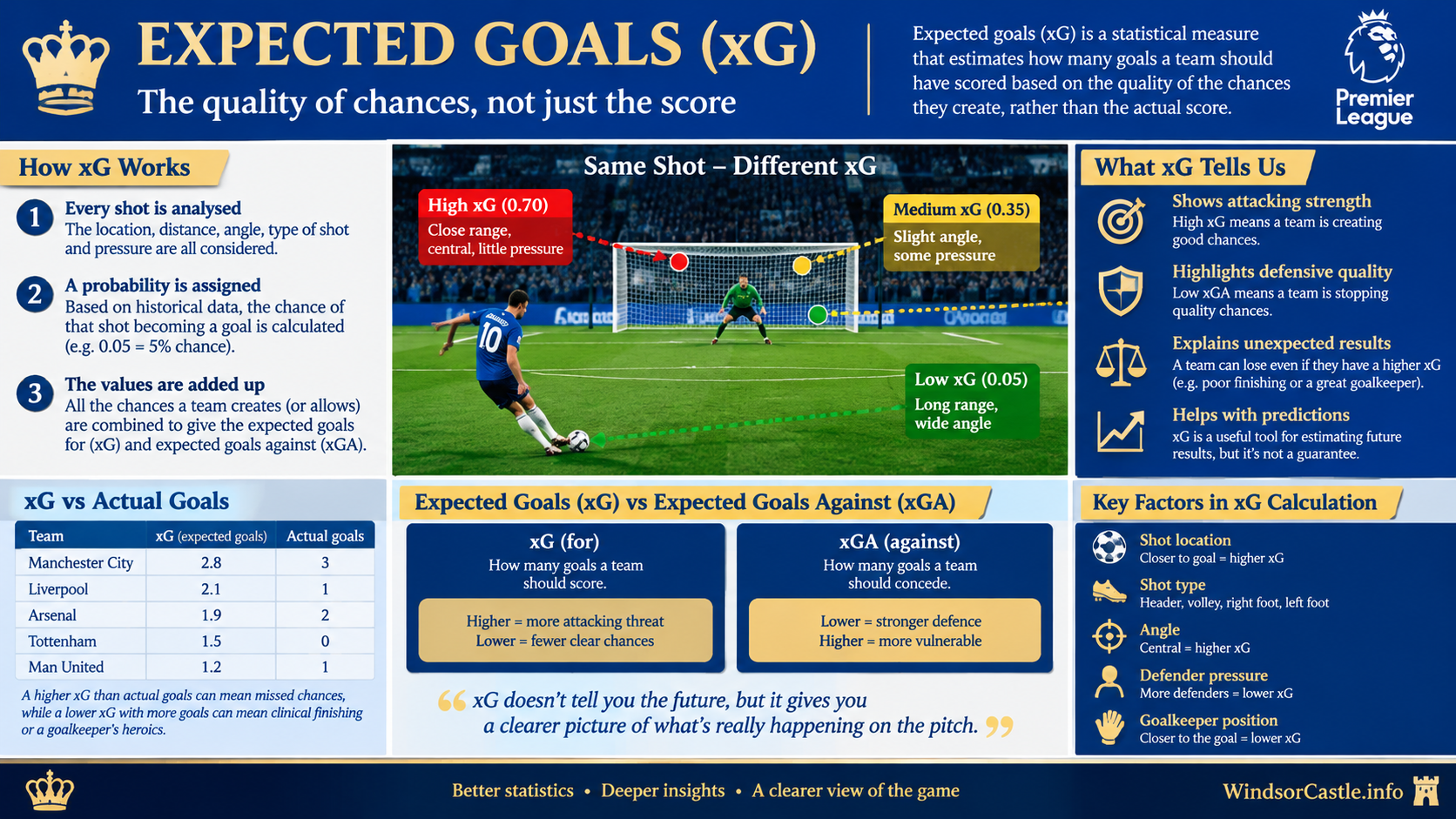
    Football is full of surprises. A team can have more possession, take more shots and still lose. Expected goals (xG) helps explain why: it estimates the quality of the chances created, rather than simply counting attempts. For Matchweek 7, this guide combines the published fixture list and available season-level xG figures with cautious score predictions, arguments for and against each outcome, an upset watch and a defensive players focus.

    Important: The scorelines and match-by-match xG ranges below are editorial estimates, not official Premier League forecasts, betting advice or guarantees. They are not generated by a calibrated match-prediction model. Published team-season xG figures are identified separately.

    What does expected goals (xG) mean?

    Expected goals assigns each shot a probability of becoming a goal, based on factors such as shot location, angle, type of assist, body part and the situation. A chance worth 0.20 xG would, in a large set of similar chances, be scored roughly 20 times out of 100. It does not mean that a particular shot has to be scored.

    • 0.05 xG: a difficult chance with a low probability of scoring.
    • 0.30 xG: a more promising opportunity.
    • 0.75 xG: a very clear chance, although not a guaranteed goal.

    A team’s xG is the total value of its shots. Expected goals against (xGA) totals the quality of the shots it allows. Some providers use slightly different models, so numbers from different websites may not match exactly.

    Example: if a side creates chances worth 1.8 xG and its opponent creates 0.7 xG, the first team has created the better opportunities overall. It can still lose 0–1 if it misses its chances and the opponent scores one of theirs. One match is a small sample; xG is most useful when viewed over a run of games.

    What the early-season numbers suggest

    A published Matchday 7 xG table records the following figures after six matches for most clubs (Newcastle and Coventry had played five in the snapshot). These are season-to-date totals, not forecasts for this weekend:

    Club Season xG Season xGA What it may suggest
    Arsenal 11.08 6.03 Strong chance creation paired with a low volume of high-quality chances conceded.
    Manchester City 12.65 8.21 High attacking output; the defence still has opportunities to tighten.
    Nottingham Forest 11.54 7.45 Promising chance creation and defensive underlying numbers, despite poor finishing so far.
    Brighton 14.09 10.46 High chance creation, but matches may remain open if opponents also find opportunities.
    Liverpool 8.32 7.83 The early sample points to a smaller xG margin than some supporters might expect.
    Crystal Palace 10.19 13.91 Conceded chance quality is a concern to monitor.

    Source snapshot: Expected Goals — Premier League Matchday 7. Figures can vary by data provider. The Premier League’s own statistics guide explains its categories and data collection: Premier League statistics explained.

    Matchweek 7: fixtures and predictions

    All times below are UK local time. Predicted xG ranges are illustrative analyst estimates to communicate the expected balance of chances; they are not the season totals above or verified provider forecasts.

    Saturday 17 October

    Everton v Chelsea — 12:30

    Prediction: 1–1 draw. Illustrative xG: Everton 0.9–1.3; Chelsea 1.0–1.5.

    For: Chelsea may have the technical quality to create more of the clear openings, while Everton’s home support can help them compete and make the game uncomfortable. Against: the Premier League preview notes Everton’s unbeaten start, so treating them as easy opponents would be a mistake. Chelsea could win if they turn possession into high-quality shots; Everton could take all three points if they attack transitions and set pieces well.

    Brentford v Liverpool — 15:00

    Prediction: Brentford 1–2 Liverpool. Illustrative xG: Brentford 1.0–1.5; Liverpool 1.2–1.7.

    For: Liverpool have the attacking quality to punish turnovers, and a response after a difficult run would be a strong motivation. Against: Brentford are described in the official preview as a bullish opponent; direct play, second balls and set pieces could trouble Liverpool. An early Brentford goal would make this a genuine upset candidate.

    Fulham v Hull City — 15:00

    Prediction: Fulham 2–1 Hull. Illustrative xG: Fulham 1.2–1.7; Hull 0.8–1.3.

    For: Fulham have home advantage and the chance to press the game. Against: Hull’s early-season performances make this more competitive than reputation alone suggests. If Hull defend the central areas and counter efficiently, a draw or away win is possible.

    Manchester City v Ipswich Town — 15:00

    Prediction: Manchester City 3–0 Ipswich. Illustrative xG: City 2.0–2.7; Ipswich 0.4–0.9.

    For: City have generated a strong season xG total, and the official preview highlights the possibility of a record start. Against: a high defensive line can be vulnerable to quick runs in behind, and an early missed chance or goal conceded can change the game. Ipswich’s upset route is to stay compact, exploit transitions and make set pieces count.

    Newcastle United v Aston Villa — 17:30

    Prediction: 1–1 draw. Illustrative xG: Newcastle 1.0–1.5; Villa 1.0–1.6.

    For: Newcastle’s home crowd can make the match intense, while Villa’s new-look forward line may find spaces if Newcastle’s defensive shape breaks. Against: Newcastle’s season-to-date sample is small and its xG figures need caution. Villa’s attacking changes may take time to click; a scrappy midfield battle could limit chances at both ends.

    Sunday 18 October

    Bournemouth v Sunderland — 14:00

    Prediction: Bournemouth 2–1 Sunderland. Illustrative xG: Bournemouth 1.3–1.8; Sunderland 0.8–1.3.

    For: Bournemouth can use tempo and home advantage to create pressure. Against: Sunderland have already shown they should not be underestimated. If they win second balls and keep Bournemouth away from the penalty spot, a draw is realistic.

    Brighton v Crystal Palace — 14:00

    Prediction: 1–1 draw. Illustrative xG: Brighton 1.2–1.7; Palace 0.8–1.3.

    For: Brighton’s season xG total points to plenty of attacking activity. Against: Palace can frustrate opponents with disciplined defensive coaching and quick breaks. The derby’s emotion can override the statistical picture; a Palace set-piece goal or Brighton finishing burst could swing it either way.

    Leeds United v Manchester United — 14:00

    Prediction: 1–1 draw. Illustrative xG: Leeds 1.0–1.5; United 1.0–1.6.

    For: United can threaten if they play through Leeds’ pressure and create chances close to goal. Against: the official preview flags Leeds’ tough-tackling midfield. If United are forced into low-quality long-range shots, their possession may not translate into much xG. Leeds can upset the prediction through intensity, set pieces and second-ball wins.

    Nottingham Forest v Arsenal — 16:30

    Prediction: Forest 0–1 Arsenal. Illustrative xG: Forest 0.7–1.2; Arsenal 1.0–1.5.

    For: Arsenal’s season xGA of 6.03 is among the strongest in the published snapshot, and the official preview identifies both sides as strong performers for expected goals conceded. Against: Forest have created chances but have been let down by finishing. The previous two league visits by Arsenal to the City Ground ended 0–0, according to the Premier League preview. Forest are a credible upset pick if they convert early and keep Arsenal’s forwards away from dangerous areas.

    Monday 19 October

    Tottenham Hotspur v Coventry City — 20:00

    Prediction: Tottenham 1–1 Coventry. Illustrative xG: Spurs 1.1–1.6; Coventry 0.8–1.3.

    For: Spurs have home advantage and the squad depth to create opportunities. Against: the Premier League preview highlights Coventry’s winning streak and Tottenham’s winless run. If Coventry stay organised and attack quickly, an away result is possible. This is one of the weekend’s most intriguing upset watches.

    Upset watch: three results that could surprise

    1. Forest to beat or draw with Arsenal. Forest’s chance creation has been stronger than their goal return. Clinical finishing could turn a tight game.
    2. Coventry to take points at Tottenham. Confidence and organisation can matter as much as reputation, particularly if Spurs struggle to convert possession into good chances.
    3. Hull to take points at Fulham. Hull’s early results suggest Fulham should not assume this is a routine home win.

    An upset becomes more plausible when the favourite creates lots of low-probability shots rather than clear chances, loses possession in dangerous areas, concedes set pieces or has to chase the match after falling behind. It is still an upset: the less-favoured team can execute the plan perfectly and lose.

    Defensive Players Focus: what to watch

    Defending is more than making a last-ditch tackle. A strong defender reads danger early, blocks the passing lane, wins aerial duels, protects the space behind the full-back and helps the team recover the ball without conceding a dangerous shot.

    • Arsenal — William Saliba and Gabriel Magalhães, if selected: watch their positioning, aerial strength and ability to defend Forest’s transitions. The key test is whether they can prevent Forest’s promising build-up from becoming shots in the penalty area.
    • Liverpool — Virgil van Dijk, if selected: watch his organisation of the defensive line, aerial duels and decisions when Brentford play direct. The second ball after a clearance may be just as important as the first header.
    • Manchester City — centre-backs and holding midfielder: against Ipswich, the challenge is to protect space behind the defence and stop counter-attacks before they become one-on-one situations.
    • Crystal Palace — central defenders and defensive midfielders: against Brighton’s attacking volume, track blocks, interceptions and whether Palace can force shots from less dangerous positions.
    • Everton — goalkeeper and centre-backs: Chelsea may create dangerous combinations around the box. Communication, close-range saves and defending cut-backs could decide the contest.
    • Goalkeepers across the round: saves should be judged alongside shot quality. A goalkeeper facing several low-xG efforts has a different task from one repeatedly facing close-range chances.

    These are players and roles to watch, not a claim that they will start or lead the statistics this weekend. Confirm team selections and availability on match day. For a fair assessment, combine tackles and interceptions with blocks, clearances, aerial duels, errors leading to shots and the team’s xGA. A defender can have few tackles because excellent positioning prevented the opponent from reaching dangerous areas.

    Why xG can be wrong about a single match

    • Finishing quality: some players consistently finish better than average, while short-term hot or cold streaks can distort results.
    • Red cards and injuries: the match can change dramatically after the model’s pre-match assumptions.
    • Game state: a team leading 2–0 may deliberately defend deeper and allow more shots from distance.
    • Set pieces and rebounds: providers may model these situations differently.
    • Small samples: six matches provide useful clues, not a definitive ranking of a team’s true ability.

    Final verdict

    Arsenal’s defensive underlying numbers make the Forest match a fascinating tactical test; Manchester City look the strongest predicted winner on paper against Ipswich; and Tottenham–Coventry could be more difficult for the hosts than the club names suggest. Brentford’s direct threat, Forest’s finishing, and Hull and Coventry’s confidence offer several routes to surprise results.

    The best use of xG is not to claim certainty. It is to ask better questions: Who is creating the clearer chances? Which defence is allowing them? And are recent results supported by the underlying performance?

    Sources and further reading

    Editorial note: this is an independent football preview. Team news, line-ups and fixtures may change. Re-check official sources before kick-off.

    2026 Technology (3) Agentic AI (1) AI (5) Artificial Intelligence (3) Blog (101) British Royal Family (2) Castle (109) Changing of the Guard (2) Data Centres (1) dea (82) drink (94) England (5) food (92) football (7) Future (2) Future Technology (3) Investing (1) medication (92) Orbital Data Centres (1) Prediction (3) Premier League 26/27 (5) royal landmarks UK (2) Satellites (1) Science Fiction (2) soccer (5) Space Computing (1) Space Technology (1) SPCX (1) Starmind (1) Starship (1) Technology (2) Thca (2) visiting windsor castle (3) Windsor (103) Windsor 2026 (2) Windsor castle blog (110) Windsor Castle walk (2) Windsor Drinks (102) Windsor Great Park (2) Windsor hungry (97) Windsor Long Walk (3) Windsor tourism (3) Windsor travel blog (3) World Cup (3) World Cup 2026 (2)
  • Could Artificial Intelligence Predict the Future? | AI and Time

    Could Artificial Intelligence Predict the Future? | AI and Time

    Abstract artificial intelligence network representing computer prediction of possible futures

    Could artificial intelligence predict the future? AI can analyse enormous quantities of information, identify patterns and build computer simulations of possible outcomes. But forecasting a possible future is very different from actually knowing what will happen.

    Could AI Predict the Future?

    Imagine asking a powerful computer: “What will the world look like tomorrow?” An AI system could examine weather, economic activity, scientific research, transport, population changes, technology and human behaviour, then calculate the probabilities of different outcomes.

    AI can model possible futures without travelling into the future.

    How Could AI Make Predictions?

    AI systems learn patterns from large datasets. Depending on the problem, they can use historical weather information, economic data, satellite observations, energy consumption, population statistics, scientific measurements and previous human behaviour to produce forecasts.

    The important word is probability. A responsible AI forecast should not pretend that an uncertain result is a certainty. Instead, it can show which outcomes appear more likely based on the information and assumptions available.

    The Future as a Computer Simulation

    One fascinating possibility is that AI could construct simulations containing many possible futures. A present-day situation could branch into several scenarios: economic growth, technological change, environmental disruption, scientific discovery or an unexpected event. Each scenario could then branch again.

    This does not mean the computer has travelled through time. It means that the computer has created mathematical possibilities about what could happen next.

    Governments Already Explore Future Scenarios

    Future scenarios are already used in serious research and policymaking. The UK Government Office for Science AI Scenarios 2030 examines possible ways AI could develop and affect society, security, geopolitics and the economy. The OECD has also published work exploring possible AI trajectories through 2030.

    These scenarios are not guaranteed predictions. Their purpose is to help people think about different possible futures and prepare for uncertainty.

    Why Can’t AI Simply See the Future?

    The future contains information that does not yet exist. New inventions, scientific discoveries, political decisions, natural events and human choices can all change what happens next.

    Complex systems can also be extremely sensitive to small changes. A tiny difference in the starting conditions can eventually produce a very different result. This is one reason why long-range forecasting can become increasingly uncertain.

    Research in Nature Computational Science has considered fundamental limits of prediction, including the difficulty of making reliable long-term predictions in complex social systems.

    Prediction Is Not Time Travel

    This is where artificial intelligence becomes particularly interesting for the study of time travel.

    Computational time travel: a computer uses present information to simulate possible futures.

    Physical time travel: a person or object actually experiences a different passage of time because of physical processes such as relativistic time dilation.

    NASA explains that Einstein’s theory of relativity leads to measurable effects in which time passes differently for observers moving at different speeds. That is a physics question rather than an AI forecasting problem.

    Could AI Calculate Thousands of Possible Futures?

    Imagine an AI system producing thousands of simulated outcomes. One future might be assigned a 45% probability, another 30%, another 15%, with the remaining possibilities making up the rest.

    The AI would not be saying that the 45% future definitely happens. It would be saying that, under the model’s assumptions, that outcome appears more likely than the alternatives.

    Could AI Predict Its Own Future?

    AI can also be used to examine possible futures for AI itself. Research organisations can construct different scenarios for technological development, economic effects, regulation and adoption.

    This creates an intriguing feedback loop: AI helps predict technological change, technological change improves AI, and improved AI creates new forecasts.

    The Future Is Still Unwritten

    Artificial intelligence may become extraordinarily good at recognising patterns and calculating probabilities, but prediction has limits. The future is shaped by physical laws, chance, human decisions, discoveries and events that have not happened yet.

    Perhaps the ultimate AI time machine will not take us into the future. Perhaps it will let us explore thousands of possible roads before choosing which one to take.

    Explore More Time-Travel Articles and Stories

    Continue exploring time travel, science, artificial intelligence, paradoxes and future technology at Time-Travel.Space.

    You can also explore more articles and stories on WindsorCastle.info.

    Sources and Further Reading

    Featured image credit: Growtika via Unsplash. Image sourced through WPVibe/Unsplash and uploaded to WindsorCastle.info. Image alt text: Abstract artificial intelligence network representing computer prediction of possible futures.

    SEO keywords: AI future prediction, artificial intelligence, future technology, time travel AI, computer simulation, AI forecasting, predicting the future, future simulation.

X (Twitter)20
URL has been copied successfully!