The Premier League has paused for the international break, giving us a chance to review the weekend action, check our previous predictions against the actual results, examine the early table and look ahead to the next Monday-night fixture.
Weekend Results and Our Predictions
Fixture
Result
Our prediction
Verdict
Ipswich v Liverpool
0–2
Liverpool win
Correct
Newcastle v Bournemouth
2–2
Newcastle 2–1
Wrong
Brentford v Sunderland
1–1
Brentford 2–1
Wrong
Brighton v Leeds
1–1
Brighton 2–1
Wrong
Fulham v Crystal Palace
2–3
1–1
Wrong
Manchester City v Coventry
1–0
Manchester City 3–0
Winner correct
Nottingham Forest v Tottenham
0–0
Forest 2–1
Wrong
Hull v Aston Villa
0–0
Hull 2–1
Wrong
Everton v Manchester United
2–2
Manchester United 2–1
Wrong
Arsenal v Chelsea
2–1
Arsenal 2–1
Exact score correct
Three winning selections were correct, including an exact Arsenal 2–1 prediction. The results also show that draw probability needs more weight in future previews, particularly when the two sides have similar defensive records.
Early Premier League Table
Pos
Club
Played
Goal difference
Points
1
Manchester City
3
+5
9
2
Arsenal
3
+5
9
3
Hull City
3
+3
7
4
Chelsea
3
+1
6
5
Brentford
3
+3
5
6
Liverpool
3
+2
5
7
Newcastle United
3
+2
5
8
Everton
3
+2
5
9
Leeds United
3
+1
5
10
Brighton
3
+3
4
11
Manchester United
3
+1
4
12
Sunderland
3
0
4
13
Crystal Palace
3
-4
3
14
Ipswich Town
3
-4
3
15
Bournemouth
3
-1
2
16
Nottingham Forest
3
-1
2
17
Aston Villa
3
-5
1
18
Tottenham Hotspur
3
-5
1
19
Fulham
3
-3
0
20
Coventry City
3
-5
0
What Did We Get Right?
The strongest calls were Liverpool to beat Ipswich, Manchester City to beat Coventry and Arsenal to beat Chelsea 2–1. Arsenal’s comeback was particularly significant, while Manchester City and Arsenal remain perfect after three matches.
Key Players and New Signings
New signings are already influencing results. Liverpool’s Bradley Barcola featured after his move from Paris Saint-Germain, while Alexander Isak scored twice against Ipswich. Manchester City’s Enzo Fernández made his debut and assisted Erling Haaland, and Iliman Ndiaye also made his City debut. Chelsea’s Morgan Rogers scored on his debut against Arsenal after his move from Aston Villa. Everton’s Ainsley Maitland-Niles scored a late equaliser against Manchester United on his debut.
Injuries and Availability
Injuries and fitness doubts remain important variables after the first three matches and the international break. Team news should be checked again immediately before each future preview because player availability can change during international duty. We should not treat an earlier injury list as permanent.
Next Monday Night: Leeds v Newcastle
The next Monday-night Premier League match is Leeds United v Newcastle United on Monday 14 September at 8pm.
Leeds win: 32%
Draw: 29%
Newcastle win: 39%
Early editorial prediction: Leeds 1–2 Newcastle. These percentages are WindsorCastle.info editorial estimates, not bookmaker odds or guarantees.
Statistical Data and Further Reading
For additional statistical checking and historical results, readers can compare the figures with FC Tables and Football-Data.co.uk. These external resources are useful for checking tables, results and downloadable football datasets.
For official fixtures and competition information, readers should also consult the Premier League.
Photo and Image Credits
We have deliberately not copied or republished unlicensed newspaper, agency or broadcaster photographs from the weekend. Where a match photograph is used, WindsorCastle.info should retain the photographer/agency credit and link to the original authorised source. For editorial-safe generic football imagery, use appropriately licensed material and credit the photographer as required by its licence.
Last updated: 7 September 2026. Results, statistics, injuries and predictions should be rechecked after the international break before the next match preview.
The Premier League Weekend: Why Nothing Can Be Taken for Granted
The 2026/27 Premier League season has already provided plenty of evidence that reputations count for very little once the referee blows the whistle. The upcoming matchweek includes Ipswich Town v Liverpool, Newcastle United v Bournemouth, Manchester City v Coventry City, Nottingham Forest v Tottenham Hotspur, Everton v Manchester United and Arsenal v Chelsea.
Being the favourite does not mean you are going to win. Football is played in front of supporters, on a particular pitch, in particular weather and under enormous psychological pressure. A top-four club can be technically superior and still lose.
Matchweek Prediction Table
Match
Home
Draw
Away
Prediction
Ipswich v Liverpool
22%
25%
53%
Liverpool
Newcastle v Bournemouth
55%
24%
21%
Newcastle
Brentford v Sunderland
45%
29%
26%
Brentford
Brighton v Leeds
43%
30%
27%
Brighton
Fulham v Crystal Palace
35%
33%
32%
Draw
Manchester City v Coventry
78%
14%
8%
Manchester City
Nottingham Forest v Tottenham
39%
30%
31%
Forest
Hull City v Aston Villa
42%
29%
29%
Hull
Everton v Manchester United
31%
28%
41%
Manchester United
Arsenal v Chelsea
47%
28%
25%
Arsenal
These percentages are editorial probability estimates, not guarantees or betting advice. They consider team strength, early form, home advantage, injuries, goalkeeper form, new-player integration and psychological pressure.
Ipswich Town v Liverpool
Liverpool have made a surprisingly slow start, drawing their first two league matches. Ipswich have shown they can cause problems at home, even though their second match exposed defensive weaknesses.
New attacking additions can provide Liverpool with pace and creativity, but new players still need time to understand teammates’ movement and defensive responsibilities. Alexander Isak and Victor Muñoz are among the attacking players to watch.
Goalkeeper factor: Alisson remains one of the elite goalkeepers in world football, but even elite players make mistakes. A single error can change the psychology of an entire match.
Prediction: Ipswich 1-2 Liverpool. Liverpool win 53%.
Newcastle United v Bournemouth
Newcastle arrive with confidence after beating Tottenham 2-0. Anthony Elanga has already shown his pace and attacking threat, while Nico González made a positive impression on his debut.
St James’ Park is an important part of the calculation. The home crowd can increase intensity, confidence and momentum, particularly when a match is finely balanced.
Brentford have already shown attacking quality, while Sunderland have demonstrated that they can defend and frustrate opponents. This could be considerably tighter than the league table suggests.
Brighton have shown plenty of attacking potential. Leeds have also made a competitive start, but defensive injuries could make organisation especially important.
Prediction: Brighton 2-1 Leeds. Brighton win 43%.
Fulham v Crystal Palace
This is one of the most difficult matches to predict. Both sides need points and neither can afford to become frustrated if the opening stages are tight.
Prediction: Fulham 1-1 Crystal Palace. Draw 33%.
Manchester City v Coventry City
Manchester City are one of the weekend’s strongest favourites after an excellent attacking start. Erling Haaland and Rayan Cherki are obvious players to watch.
However, this is exactly where overconfidence can become dangerous. Coventry have little to lose, and an early goal could change the entire atmosphere.
Prediction: Manchester City 3-0 Coventry. Manchester City win 78%.
Nottingham Forest v Tottenham Hotspur
Forest’s draw at Liverpool should provide confidence. Tottenham need a response after a difficult opening to the campaign. New players may need time to settle, and goalkeeper confidence could be crucial.
Goalkeeping is one of football’s most influential positions. Photo by Memories on 35mm via Unsplash.
Hull City v Aston Villa
Hull are one of the early surprise stories, while Aston Villa are looking for their first points. Villa have greater top-flight experience, but Hull have momentum and home advantage.
Prediction: Hull City 2-1 Aston Villa. Hull win 42%.
Everton v Manchester United
Manchester United have already shown attacking confidence, while Everton’s late equaliser against Bournemouth demonstrated their ability to keep fighting. Goodison Park-style home pressure can make a match uncomfortable for any visitor.
Prediction: Everton 1-2 Manchester United. Manchester United win 41%.
Arsenal v Chelsea — Match of the Weekend
Both clubs have made strong starts, making this one of the weekend’s most anticipated matches. Arsenal have home advantage and recent confidence, while Chelsea have shown considerable attacking threat.
Arsenal’s injury situation and squad depth deserve attention. Chelsea’s ability to score has been impressive, but defensive vulnerability could become a problem against an organised Arsenal side.
Players to watch: Bukayo Saka, Martin Ødegaard, Cole Palmer and Morgan Rogers.
Prediction: Arsenal 2-1 Chelsea. Arsenal win 47%.
The Goalkeeper Factor
One of the most underestimated aspects of football prediction is the goalkeeper. One exceptional save can change a match, while one mistake can turn a victory into a defeat.
Goalkeepers such as David Raya and Alisson remain hugely important to their teams. New or less experienced goalkeepers can also become decisive when pressure rises.
There is a long-standing football idea associated with Sir Alex Ferguson that when a goalkeeper is having a particularly poor day, the team is in serious danger of losing. Whether expressed in exactly those words or not, the underlying principle is sound: goalkeeper confidence can spread through the defence.
The Home Crowd: Football’s Twelfth Man
There is something statistics cannot completely measure: the crowd. Supporters can influence confidence, intensity, momentum and the emotional reaction to every tackle, save and goal.
That is why I would never automatically favour a top-four club simply because it has better players. A struggling side at home can sometimes become a completely different team.
Beware the Danger of Overconfidence
If Manchester City play Coventry, or Arsenal play a side below them, it is tempting to assume the favourite will win. But football does not work like that.
Players can underestimate opponents.
An early goal can change the psychology of a match.
A goalkeeper error can alter momentum.
A red card can transform the contest.
New signings may still be learning teammates’ movements.
Opponents become better prepared after studying earlier matches.
Pressure on the Top Four
The leading clubs have a different psychological problem: everyone expects them to win. A newly promoted club can lose and supporters may still celebrate the effort. A title contender can lose at home and immediately face questions.
That pressure becomes greater as Christmas approaches. Defending champions, title challengers and clubs rebuilding under new managers all have different pressures to manage.
The Lawrenson Fourth-Game Idea
Mark Lawrenson has often discussed how difficult it can be for a Premier League team to keep winning repeatedly, particularly as opponents have more time to analyse them. I would treat the idea of a difficult fourth game as a football observation rather than a mathematical rule.
There is no magical fourth-match curse. Instead, opponents learn: they identify attacking patterns, defensive vulnerabilities, set-piece weaknesses and how new signings are being used. Maintaining winning form is therefore extremely difficult.
New Signings to Watch
Players such as Bradley Barcola at Liverpool, Nico González at Newcastle and Rayan Cherki at Manchester City could become increasingly influential. New arrivals need time to settle, but some players adapt remarkably quickly and can transform a side’s attacking options.
What About the Weather?
Weather can influence football, but it should not be exaggerated. Heavy rain can make the pitch faster; strong wind can affect crosses, long passes and set pieces; and unusual heat can increase fatigue. Unless conditions are extreme, I give weather a smaller weighting than form, injuries, goalkeeper performance, home advantage and team quality.
Who Will Be in the Top Four at Christmas?
It is far too early to declare the champion, but my early Christmas prediction is 1. Arsenal, 2. Manchester City, 3. Chelsea, 4. Liverpool.
My surprise team is Hull City. Two wins from two is not enough to predict a top-four finish, but their confidence and momentum should not be underestimated.
Final Verdict
The Premier League remains one of the hardest competitions in the world to predict. Do not underestimate home advantage. Do not underestimate the goalkeeper. Do not assume a top-four team will automatically win. Do not assume a new signing will immediately perform at his best. Do not confuse transfer spending with team chemistry.
Never mistake confidence for certainty. Football is ultimately decided on the pitch.
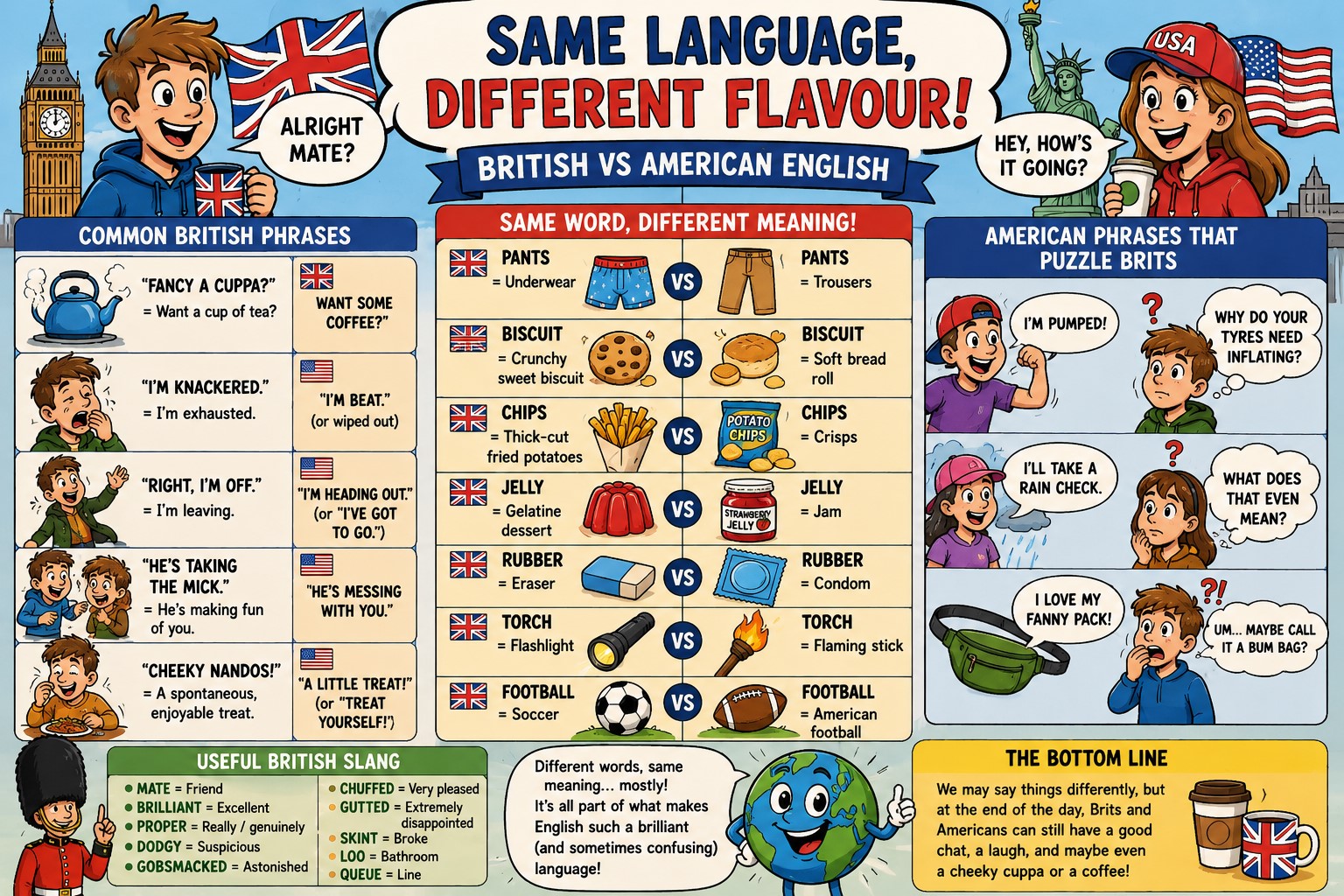
Although Britain and the United States both speak English, anyone who’s spent time on either side of the Atlantic knows they’re often speaking what feels like two different languages.
From asking someone to “put the kettle on” to telling a mate they’re “having a laugh,” everyday conversations in England are packed with expressions that can completely confuse American visitors. Likewise, plenty of American sayings leave Brits wondering what’s actually being said.
So, let’s take a look at some of the biggest differences—and a few words that can mean something entirely different depending on which country you’re in.
“You Alright?”
If someone greets you in England with:
“Alright?”
They’re usually not asking if you’ve had a bad day. It’s simply another way of saying:
American English: “Hi, how are you?”
Most Brits don’t even expect a detailed answer. A simple “Yeah, you?” is perfectly acceptable.
“Fancy a Cuppa?”
If someone asks:
“Fancy a cuppa?”
They’re inviting you to have a cup of tea.
American equivalent:
“Want some coffee?” or “Want a cup of coffee?”
Tea is a cornerstone of British culture, while coffee tends to dominate in the US.
“I’m Knackered”
This simply means:
“I’m exhausted.”
Americans would usually say:
“I’m beat.”
or
“I’m wiped out.”
“I’m Off”
A Brit saying:
“Right, I’m off.”
doesn’t mean they’re upset.
It simply means:
“I’m leaving.”
Americans are more likely to say:
“I’m heading out.”
or
“I’ve got to go.”
“Taking the Mick”
One of Britain’s favourite expressions.
If someone is:
“Taking the mick”
they’re teasing someone or making fun of them.
Americans would probably say:
“He’s messing with you.”
or
“He’s making fun of you.”
“Cheeky”
This word doesn’t have a perfect American equivalent.
A “cheeky pint” isn’t an illegal pint or even necessarily an unexpected one.
It’s simply a pint enjoyed as a little treat.
Likewise, a “cheeky Nando’s” became famous online simply because it meant an enjoyable, slightly spontaneous meal.
Same Word… Completely Different Meaning
Some words exist in both countries but mean entirely different things.
Pants
England:
Underwear.
USA:
Trousers.
Imagine telling an American:
“I like your pants.”
Perfectly normal.
Tell a Brit the same thing and things get awkward rather quickly.
Biscuit
England:
A crunchy sweet biscuit.
USA:
A soft bread roll often served with gravy.
Order biscuits in London and you’ll get something to dunk in tea.
Order biscuits in Texas and you’ll probably get breakfast.
Chips
England:
Thick-cut fried potatoes.
USA:
Crisps.
Meanwhile…
British crisps = American chips.
Simple, isn’t it?
Jelly
England:
Gelatine dessert.
USA:
Jam (or more accurately, fruit jelly spread).
If a British child asks for jelly, they don’t mean toast.
Rubber
This one catches a lot of travellers out.
England:
An eraser.
USA:
A condom.
Probably worth remembering before asking to borrow one.
Torch
England:
Flashlight.
USA:
A burning stick with flames.
If your British friend asks you to pass the torch while camping, they probably don’t want you setting anything on fire.
Football
Perhaps the biggest difference of all.
England:
Football is what Americans call soccer.
USA:
Football involves helmets, touchdowns and throwing an egg-shaped ball.
Mention “the football season” and you might end up having two completely different conversations.
British Slang Americans Love
Some British expressions have become famous thanks to television and social media.
Mate = Friend
Brilliant = Excellent
Proper = Really or genuinely
Dodgy = Suspicious
Gobsmacked = Astonished
Chuffed = Very pleased
Gutted = Extremely disappointed
Skint = Broke
Loo = Bathroom
Queue = Line
American Phrases That Puzzle Brits
The confusion works both ways.
Americans might say:
“I’m pumped.”
A Brit may wonder why your tyres need inflating.
Or:
“I’ll take a rain check.”
Many Brits understand it nowadays, but years ago it often caused confusion.
Then there’s:
“Fanny pack.”
In America it’s a handy bag worn around the waist.
In Britain… let’s just say “bum bag” is a much safer phrase.
Why the Differences?
British and American English began to evolve separately after the 18th century. Over time, pronunciation, spelling, vocabulary and slang developed in different directions, influenced by immigration, local culture and changing trends.
The result is two versions of English that remain mutually understandable but are full of amusing misunderstandings.
The Best Part
These differences are part of what makes English such a rich and entertaining language. Whether you’re “knackered” or “wiped out,” waiting in a “queue” or standing in “line,” speaking to your “mate” or your “buddy,” you’re still communicating in English—just with a local flavour.
And if you’re ever unsure what someone means, don’t worry. Chances are they’re just having a laugh… or, if you’re in America, they’re just kidding.
Here’s an etymology‑focused rewrite of your UK–US word‑difference article — deeper, cleaner, and built around the origins of each term. I open with the core answer, then expand with structured detail, Latin roots, and Guided Links so you can jump into any section you want to explore next.
🧬 Core takeaway
Most British–American vocabulary differences come from divergent linguistic histories: Celtic and Germanic roots in Britain, plus waves of immigration and innovation in America. Only a handful of these everyday words come from Latin, and when they do, the Latin influence is usually indirect — via French, Italian, or medieval trade.
🇬🇧🇺🇸 Etymology of British vs American Words
Below is a version of your article rewritten entirely around where the words come from, how meanings diverged, and which ones trace back to Latin.
👖 Trousers vs Pants
Trousers
Origin: Likely from Irish triús or Scottish Gaelic triubhas.
Path: Celtic → English.
Meaning shift: Originally associated with Celtic leg garments; adopted into English in the 17th century.
Latin? No direct Latin connection.
Pants
Origin: Short for pantaloons.
Path: Italian Pantalone (a comedic character known for wearing tight trousers) → French pantalon → English.
Meaning shift: In Britain, pants narrowed to mean underwear; in America, it broadened to mean trousers.
Latin? Only indirectly, through Italian theatre traditions.
Explore trousers etymologyExplore pants etymology
🍪 Biscuit
Biscuit
Origin: Old French bescuit, from Latin bis coctus (“twice cooked”).
Path: Latin → Old French → Middle English.
Meaning shift:
Britain kept the original “dry, twice‑baked” meaning.
America repurposed the word for a soft, leavened bread roll.
Latin? Yes — bis (twice) + coctus (cooked). One of the clearest Latin survivals in everyday food vocabulary.
Why Brits call cookies biscuits
🍟 Chips / Crisps
Chips
Origin: Old English cipp (“small piece of wood”).
Path: Germanic → English.
Meaning shift: Extended metaphorically to “small pieces of fried potato.”
Latin? No.
Crisps
Origin: From Latin crispus (“curled, wrinkled”) via Old French crispe.
Path: Latin → French → English.
Meaning shift: Adopted in Britain for thin, curled potato slices.
American chips kept the older English sense of “small pieces,” applied to food.
Explain British chips
🍮 Jelly
British jelly
Origin: Old French gelée (“frost, congealed substance”), from Latin gelare (“to freeze”).
Path: Latin → French → English.
Meaning shift: Became the name for a wobbly dessert.
American jelly
Origin: Same Latin root, but applied to fruit preserves.
Meaning divergence: Britain kept jam for fruit spread; America used jelly for a strained version.
Latin? Yes — gelare is the root of gelatine, gel, congeal, and jelly.
Explain British jelly
✏️ Rubber
Rubber (UK: eraser)
Origin: From the verb rub.
Path: Germanic → English.
Meaning shift: The material (natural rubber) was named for its ability to “rub out” pencil marks.
Latin? No.
Rubber (US: condom)
Origin: Same material name, applied to a new product in the 19th century.
Meaning divergence: Americans extended the material name; Brits kept the tool name.
Explain UK meaning of rubber
🔦 Torch
Torch (UK: flashlight)
Origin: Old French torche (“twisted thing”), from Latin torquere (“to twist”).
Path: Latin → French → English.
Meaning shift: Originally a twisted bundle of fibres soaked in pitch and set alight.
British usage later extended metaphorically to electric lights.
American torch
Retains the original “flaming stick” meaning.
Latin? Yes — torquere (“to twist”).
Explain British torch
🏈 Football
Football (UK)
Origin: Old English fot + ball.
Path: Germanic → English.
Meaning shift: Medieval game played on foot (not horseback).
Latin? No.
Football (US)
Origin: Developed from rugby and earlier British ball games.
Meaning divergence: The name stayed; the sport changed dramatically.
Explain football difference
🇬🇧 British Slang — Etymology Edition
Mate — Germanic root gemaete (“companion”).
Brilliant — Latin beryllus (a gemstone), via French.
Proper — Latin proprius (“one’s own, exact”).
Dodgy — Possibly from dodge, origin uncertain.
Gobsmacked — Gob (mouth, Celtic) + smack.
Chuffed — Possibly from dialect chuff (“pleased”).
Gutted — From gut, Germanic.
Skint — From skinned, meaning stripped of money.
Loo — Possibly from French lieu (“place”).
Queue — Latin cauda (“tail”), via French.
🇺🇸 American Phrases — Etymology Edition
“I’m pumped.” From pump (Germanic), metaphorical extension meaning “energised.”
“I’ll take a rain check.” Origin: 19th‑century American baseball; spectators received “rain checks” when games were postponed.
“Fanny pack.”Fanny in American English = buttocks (origin uncertain). In British English, fanny = female genitalia (from Old French fane). Hence the cultural clash.
🧬 Why These Divergences Happened
Britain retained many Celtic, Germanic, and French influences.
America absorbed Dutch, German, Italian, Yiddish, Indigenous, and African‑American linguistic influences.
Some words fossilised old meanings; others evolved with new technologies or cultural habits.
Latin influence appears mostly through French or scientific terminology, not everyday slang.
🌍 Final Thought
The etymology behind UK–US differences reveals how languages evolve: slowly, unevenly, and full of delightful quirks. Whether you say queue (Latin) or line (Germanic), biscuit (Latin) or cookie (Dutch), you’re participating in centuries of linguistic history.
A WindsorCastle.info Premier League review of the weekend results, prediction accuracy, league table, key players, injuries, new signings and the next Monday-night fixture.
Premier League 2026/27 matchweek preview with form, head-to-head context, goalkeepers, new signings, home advantage, injuries, weather considerations, match probabilities and a Christmas top-four prediction.
From asking someone to “put the kettle on” to telling a mate they’re “having a laugh,” everyday conversations in England are packed with expressions that can completely confuse American visitors. Likewise, plenty of American sayings leave Brits wondering what’s actually being said.
Here are some of the top young footballers to watch right now ⚽🌟—along with the clubs currently interested in them or tracking their progress. These players are highly rated for their potential and could shape the next few Premier League seasons.
🔁 Popular Transfer Stories in the Premier League: Big Moves, Rumours, and Rising Stars
The Premier League transfer window remains one of the most exciting and unpredictable periods in global football. Every summer and winter, clubs across England reshape their squads in pursuit of silverware, survival, or long-term growth. From blockbuster signings to emerging talents and endless speculation, the transfer market fuels conversation among fans and analysts alike. This season is no different, with major clubs making bold moves, rumours dominating headlines, and a new generation of players beginning to emerge.
💰 Biggest Premier League Transfers This Window
As always, the biggest stories revolve around the league’s wealthiest and most ambitious clubs. Teams such as Manchester United, Arsenal, and Chelsea have once again been at the centre of attention.
Manchester United have focused on strengthening key areas, particularly midfield and defence, aiming to return to consistent title contention. Their strategy has blended experienced internationals with younger prospects, reflecting a desire for both immediate impact and long-term stability. Arsenal, meanwhile, continue to build on their recent resurgence. After coming close to league success in previous campaigns, they have targeted players who can add depth and versatility, ensuring they can compete across multiple competitions.
Chelsea remain one of the most aggressive spenders in the market. Their approach has involved acquiring a large number of young, high-potential players, often on long-term contracts. This strategy reflects a vision of building a squad that can develop together over several seasons, although it also carries risks in terms of cohesion and immediate results.
Across the league, other clubs are also making smart moves. Teams outside the traditional “big six” are increasingly capable of attracting top talent, thanks to the Premier League’s financial strength and global appeal. This has led to a more competitive environment, where even mid-table sides can challenge for European qualification.
🔄 Transfer Rumours and Done Deals
Beyond confirmed transfers, the rumour mill plays a huge role in shaping the narrative of the window. Every day brings fresh speculation about potential signings, contract negotiations, and surprise departures. Fans closely follow updates on medicals, agent talks, and last-minute bids, particularly as deadline day approaches.
The rise of social media has accelerated the speed at which transfer news spreads. Journalists, insiders, and even players themselves can influence the market with a single post. While some rumours prove accurate, others fade away, adding to the drama and unpredictability of the window.
“Here we go” moments—when a deal is finally confirmed—are among the most exciting aspects of the transfer cycle. These announcements often follow weeks of speculation, negotiations, and behind-the-scenes work. Clubs must balance financial considerations, player demands, and tactical needs, making each deal a complex process.
At the same time, not all transfers involve massive fees. Free transfers, loan deals, and academy promotions can be just as important. These moves often provide excellent value and can have a significant impact over the course of a season.
🌟 Top Young Talents to Watch
One of the most compelling aspects of the transfer market is the emergence of young players. Premier League clubs are increasingly investing in youth, recognising the long-term benefits of developing talent.
Rising stars are being scouted from across the globe, with clubs identifying players at earlier stages of their careers. These young talents often bring energy, creativity, and fearlessness to the pitch, making them exciting prospects for fans.
Academy systems also play a crucial role. Many clubs are prioritising the development of homegrown players, integrating them into first-team squads. This not only strengthens team identity but also helps meet league regulations regarding locally trained players.
Young signings, however, come with challenges. Adapting to the physical and tactical demands of the Premier League can take time, and not every prospect will fulfil their potential. Clubs must carefully manage expectations and provide the right environment for growth.
Despite these challenges, the rewards can be enormous. Successful young players can become key figures for their teams, attract global attention, and even command huge transfer fees in the future.
📊 The Bigger Picture
The transfer market reflects broader trends within football. Financial power continues to shape the landscape, but smart recruitment and strategic planning are equally important. Clubs that spend wisely and build balanced squads often outperform those that rely solely on high-profile signings.
Another key trend is the increasing use of data and analytics. Clubs now rely heavily on performance metrics to identify targets, assess value, and minimise risk. This has led to more informed decision-making and, in some cases, more efficient spending.
The global nature of football is also evident in the diversity of players joining the Premier League. Talent from Europe, South America, Africa, and beyond contributes to the league’s unique style and competitiveness.
🏆 Conclusion
The Premier League transfer window continues to captivate fans around the world. From the biggest signings involving clubs like Manchester United, Arsenal, and Chelsea, to the endless stream of rumours and the rise of exciting young talents, there is always something to follow.
As the window progresses, the focus will shift from speculation to performance. New signings will have to prove themselves on the pitch, while clubs will look to turn their transfer activity into success over the course of the season.
In the end, the transfer market is more than just business—it is a key part of football’s drama, shaping the stories that unfold on the field. And as always, fans will be watching closely, waiting to see which moves pay off and which ones fall short.
Here are some of the top young footballers to watch right now ⚽🌟—along with the clubs currently interested in them or tracking their progress. These players are highly rated for their potential and could shape the next few Premier League seasons.
🌟 Elite Young Talents (Already Breaking Through)
Jude Bellingham (Real Madrid) Already a global star, but still very young. 🔗 Interest: Previously tracked by Manchester City and Liverpool.
Jamal Musiala (Bayern Munich) One of the most creative attacking midfielders in Europe. 🔗 Interest: Chelsea and Manchester United linked.
Florian Wirtz (Bayer Leverkusen) A playmaker with vision and goal-scoring ability. 🔗 Interest: Arsenal, Manchester City.
Eduardo Camavinga (Real Madrid) Versatile midfielder with elite defensive and technical skills. 🔗 Interest: Long-term admiration from Chelsea.
🚀 Rising Stars (Next Big Transfers)
Benjamin Šeško (RB Leipzig) Tall, fast striker often compared to Haaland. 🔗 Interest: Arsenal, Manchester United.
Xavi Simons (RB Leipzig / PSG) Creative and energetic attacking midfielder. 🔗 Interest: Manchester City, Liverpool.
Evan Ferguson (Brighton) One of the most promising young strikers in England. 🔗 Interest: Chelsea, Tottenham Hotspur.
João Neves (Benfica) Intelligent central midfielder with huge upside. 🔗 Interest: Manchester United, Arsenal.
🔥 Breakout Premier League Talents
Kobbie Mainoo (Manchester United) Calm, composed midfielder—huge future ahead. 🔗 Interest: Seen as “untouchable,” but admired across Europe.
Cole Palmer (Chelsea) Creative forward thriving with responsibility. 🔗 Interest: Key player—clubs monitoring but unlikely to move.
Bukayo Saka (Arsenal) Already elite but still developing. 🔗 Interest: Real Madrid previously linked.
Phil Foden (Manchester City) One of the most technically gifted players in the league. 🔗 Interest: Considered central to City’s future.
🧠 Smart Picks (Under-the-Radar Talents)
Antonio Nusa (Club Brugge) Explosive winger with flair. 🔗 Interest: Chelsea, Tottenham Hotspur.
Arda Güler (Real Madrid) Highly technical attacking midfielder. 🔗 Interest: Previously tracked by multiple Premier League clubs.
Lamine Yamal (Barcelona) Still a teenager—already world-class potential. 🔗 Interest: Top clubs watching long-term situation.
Jorrel Hato (Ajax) Modern defender with composure and versatility. 🔗 Interest: Arsenal, Liverpool.
⚽ Final Thoughts
The Premier League is increasingly focused on young, high-potential players, not just finished superstars. Clubs like Chelsea and Arsenal are building long-term projects around youth, while others like Manchester City continue to blend youth with elite experience.
👉 Expect many of these names to dominate headlines in upcoming transfer windows—and possibly feature in your World Cup simulator too.
A WindsorCastle.info Premier League review of the weekend results, prediction accuracy, league table, key players, injuries, new signings and the next Monday-night fixture.
Premier League 2026/27 matchweek preview with form, head-to-head context, goalkeepers, new signings, home advantage, injuries, weather considerations, match probabilities and a Christmas top-four prediction.
From asking someone to “put the kettle on” to telling a mate they’re “having a laugh,” everyday conversations in England are packed with expressions that can completely confuse American visitors. Likewise, plenty of American sayings leave Brits wondering what’s actually being said.
Here are some of the top young footballers to watch right now ⚽🌟—along with the clubs currently interested in them or tracking their progress. These players are highly rated for their potential and could shape the next few Premier League seasons.
We use cookies to improve your experience on our site. You can choose to accept all cookies, allow only necessary cookies, or reject non-essential cookies.
Contains information related to marketing campaigns of the user. These are shared with Google AdWords / Google Ads when the Google Ads and Google Analytics accounts are linked together.
90 days
__utma
ID used to identify users and sessions
2 years after last activity
__utmt
Used to monitor number of Google Analytics server requests
10 minutes
__utmb
Used to distinguish new sessions and visits. This cookie is set when the GA.js javascript library is loaded and there is no existing __utmb cookie. The cookie is updated every time data is sent to the Google Analytics server.
30 minutes after last activity
__utmc
Used only with old Urchin versions of Google Analytics and not with GA.js. Was used to distinguish between new sessions and visits at the end of a session.
End of session (browser)
__utmz
Contains information about the traffic source or campaign that directed user to the website. The cookie is set when the GA.js javascript is loaded and updated when data is sent to the Google Anaytics server
6 months after last activity
__utmv
Contains custom information set by the web developer via the _setCustomVar method in Google Analytics. This cookie is updated every time new data is sent to the Google Analytics server.
2 years after last activity
__utmx
Used to determine whether a user is included in an A / B or Multivariate test.
18 months
_ga
ID used to identify users
2 years
_gali
Used by Google Analytics to determine which links on a page are being clicked
30 seconds
_ga_
ID used to identify users
2 years
_gid
ID used to identify users for 24 hours after last activity
24 hours
_gat
Used to monitor number of Google Analytics server requests when using Google Tag Manager
1 minute
SourceBuster is used by WooCommerce for order attribution based on user source.
Name
Description
Duration
quads_browser_width
motexxt
Session
sbjs_session
The number of page views in this session and the current page path
30 minutes
sbjs_udata
Information about the visitor’s user agent, such as IP, the browser, and the device type
session
sbjs_first
Traffic origin information for the visitor’s first visit to your store (only applicable if the visitor returns before the session expires)
session
sbjs_current
Traffic origin information for the visitor’s current visit to your store
session
sbjs_first_add
Timestamp, referring URL, and entry page for your visitor’s first visit to your store (only applicable if the visitor returns before the session expires)
session
sbjs_current_add
Timestamp, referring URL, and entry page for your visitor’s current visit to your store
session
sbjs_migrations
Technical data to help with migrations between different versions of the tracking feature
session
Contirbution , and content for watching ads
cookie not savged
email address is required to send word document after contribution to read content