From science fiction classics to cutting-edge physics, the concept of shifting through the temporal landscape has long captivated our imagination. While popular lore often points to Deloreans, blue police boxes, or microscopic wormholes, a more profound possibility exists: what if the key to time travel isn’t hidden in a standalone machine, but in the macro-motion of the cosmos itself? What if a sufficiently advanced civilization could “lock on” to a moving star or cosmic anomaly, harnessing its immense kinetic and gravitational energy to warp the fabric of space-time?
To understand how the universe’s natural motion could become a literal time machine, we have to look at the intersection of theoretical physics and speculative fiction.
1. Frame-Dragging and Rotating Universes
In physics, mass doesn’t just sit in space—when it spins, it actively drags space-time along with it, a proven phenomenon known as frame-dragging (or the Lense-Thirring effect). If you scale this up to cosmic proportions, motion becomes a doorway to the past.
The Gödel Metric (The Spinning Cosmos): In 1949, mathematician Kurt Gödel solved Einstein’s field equations by imagining a universe that was uniformly rotating. In Gödel’s universe, the rotation drags space-time so severely that it creates Closed Timelike Curves (CTCs)—paths where a ship, simply by flying in a massive circle, could catch up to its own past. You wouldn’t need a warp drive; the natural rotation of the universe would do the time-bending for you.
The Tipler Cylinder (The Infinite Star): Physicist Frank Tipler took this a step further. Instead of a whole universe, he calculated that if you took a dense star (like a neutron star), stretched it into an infinitely long cylinder, and spun it at nearly the speed of light, it would create the same CTCs. A spaceship locking onto this spinning column and spiraling around it would emerge in a different era.
2. Cosmic Strings and Relativistic Footprints
In sci-fi, we often think of space as smooth, but cutting-edge astrophysics suggests it might have literal cracks and seams.
Gott Time Machines: Physicist J. Richard Gott discovered that cosmic strings—hypothetical, ultra-dense, microscopic defects left over from the Big Birth of the universe—could manipulate time through sheer velocity. If two parallel cosmic strings fly past each other at relativistic speeds (near the speed of light), they bend space-time so acutely that a spacecraft tracing a loop around the moving pair would return to its starting point before it ever left.
3. The Sci-Fi Precedents: Navigating the Gravitational Wake
Science fiction has frequently anticipated this idea of piggybacking on cosmic motion rather than building a standalone generator.
The Slingshot Effect (Star Trek): In Star Trek IV: The Voyage Home, the crew doesn’t use a specialized time displacement device. Instead, they utilize the “slingshot effect”—accelerating a heavy ship toward a high-gravity star and using its precise orbital motion and gravitational well to slingshot backward through time.
The Ringworld and Singularity Navigation: Hard sci-fi often imagines anchoring a ship to the event horizon of a rapidly spinning Kerr (rotating) black hole. By “locking on” to the ergosphere—the region just outside the horizon where space-time is dragged faster than light—a ship can exploit gravitational time dilation to leap centuries into the future in a matter of hours.
Ultimately, if time travel is ever realized, it may not look like a machine clicking its gears in a laboratory. It will look like a stellar navigation system, charting a course into the slipstream of a moving star, riding the gravitational waves of a universe that is already doing the heavy lifting.
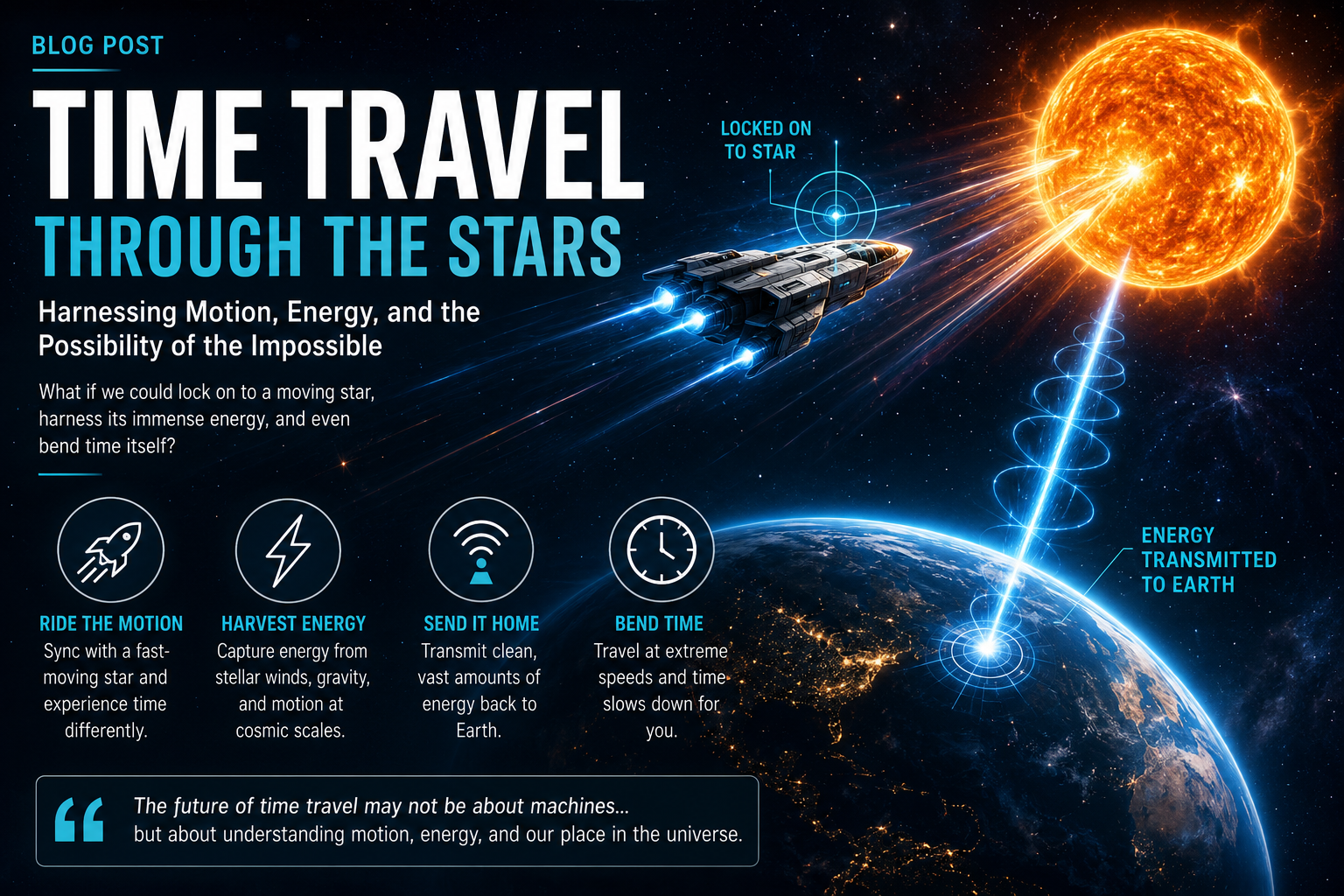
Time travel has fascinated humanity for centuries. From science fiction classics to cutting-edge physics theories, the idea of moving through time—either into the future or the past—captures our imagination. But what if the key to time travel isn’t hidden in machines or wormholes, but in the motion of the universe itself? What if we could “lock on” to a moving star and harness its immense energy to bend time?
Let’s explore this bold and intriguing concept.
The Universe is Always Moving
Nothing in the universe is truly still. Planets orbit stars, stars orbit galaxies, and galaxies themselves drift through the cosmos. Some stars travel at incredible speeds—hundreds of kilometres per second—carrying with them vast amounts of kinetic energy.
According to modern physics, motion and time are deeply connected. The faster an object moves, the more time slows down relative to a stationary observer. This is known as time dilation, a principle from Einstein’s theory of relativity.
In simple terms:
Move fast enough, and time itself begins to change.
Locking Onto a Moving Star
Imagine a future technology capable of identifying a fast-moving star and synchronising with its trajectory—a process we might call “stellar locking.”
This wouldn’t mean physically attaching to the star (which would be impossible due to extreme temperatures and radiation), but instead:
- Matching its velocity using advanced propulsion
- Aligning a spacecraft or energy system within its gravitational influence
- Using the star’s motion as a reference frame
By effectively “riding” alongside a high-speed star, a spacecraft could enter a region where time behaves differently compared to Earth.
Harvesting Energy from Motion
A moving star contains enormous kinetic energy. If we could develop a way to extract even a fraction of this energy, it could power advanced systems far beyond anything we currently understand.
Potential methods might include:
- Gravitational energy capture – using tidal forces created by the star’s motion
- Stellar wind harvesting – collecting charged particles emitted by the star
- Relativistic energy conversion – converting motion into usable energy via advanced physics mechanisms
This energy could then be transmitted back to Earth or used to power a time-altering system.
Sending Energy Back to Earth
Transmitting energy across interstellar distances is a major challenge, but not impossible in theory. Concepts include:
- Directed energy beams (like highly focused lasers)
- Quantum-linked energy transfer (a speculative future technology)
- Wave-based transmission using electromagnetic fields
If successful, Earth could receive energy generated from a star’s motion—essentially tapping into the dynamics of the universe itself.
The Time Travel Effect
So where does time travel come in?
By moving at extreme speeds alongside a star, a spacecraft would experience time more slowly than observers on Earth. For example:
- A crew might experience only a few years
- Meanwhile, decades—or even centuries—could pass on Earth
This creates a one-way form of time travel into the future.
Time Travel Through the Stars
Harnessing Motion, Energy, and the Possibility of the Impossible
The Universe is Always Moving
Nothing in the universe is truly still. Planets orbit stars, stars orbit galaxies, and galaxies drift through space. Motion and time are deeply connected. The faster you move, the slower time passes relative to others — a concept known as time dilation.
Locking Onto a Moving Star
Imagine matching the velocity of a fast-moving star. Not attaching to it, but synchronising with its motion. By aligning with its speed and gravitational influence, we could enter a new frame of time itself.
Harvesting Energy
A moving star carries enormous energy. Future technology might capture this through stellar winds, gravitational forces, or advanced energy conversion systems.
Sending Energy Back to Earth
Energy could be transmitted using focused beams or advanced electromagnetic systems. Earth could tap into the movement of the cosmos itself.
The Time Travel Effect
Travelling alongside a star at extreme speeds would slow time for the traveller. Years for them could mean decades on Earth — a real form of time travel into the future.
Challenges
Extreme heat, radiation, speed, and engineering limitations make this idea theoretical. But history shows today’s imagination can become tomorrow’s reality.
A Glimpse Into the Future
Perhaps one day humanity will ride the motion of stars themselves, bending time through understanding physics rather than breaking it.
Blog Castle Changing of the Guard dea drink England food football Heart Heart Foundation Heart process Horse Races Invest Maid Marian medication Merry Men Premier League 26/27 Python Horse Program Python Horse Tracker Robin Hood royal landmarks UK Sheriff of Nottingham Sherwood Forest soccer Thca visiting windsor castle WaterProcure.com Win Windsor Windsor castle blog Windsor Castle walk windsor castle windsor Windsor Drinks Windsor Great Park Windsor Horse Windsor Horse Races Windsor hungry Windsor Long Walk Windsor tourism Windsor travel blog Women’s Football Women’s Super League World Cup World Cup 2026 WSL Results
Leave a Reply
You must be logged in to post a comment.