Paper CM-07/2189: “Post-Monetary Systems and Symbolic Currency Architectures in Interplanetary Economies”
Abstract
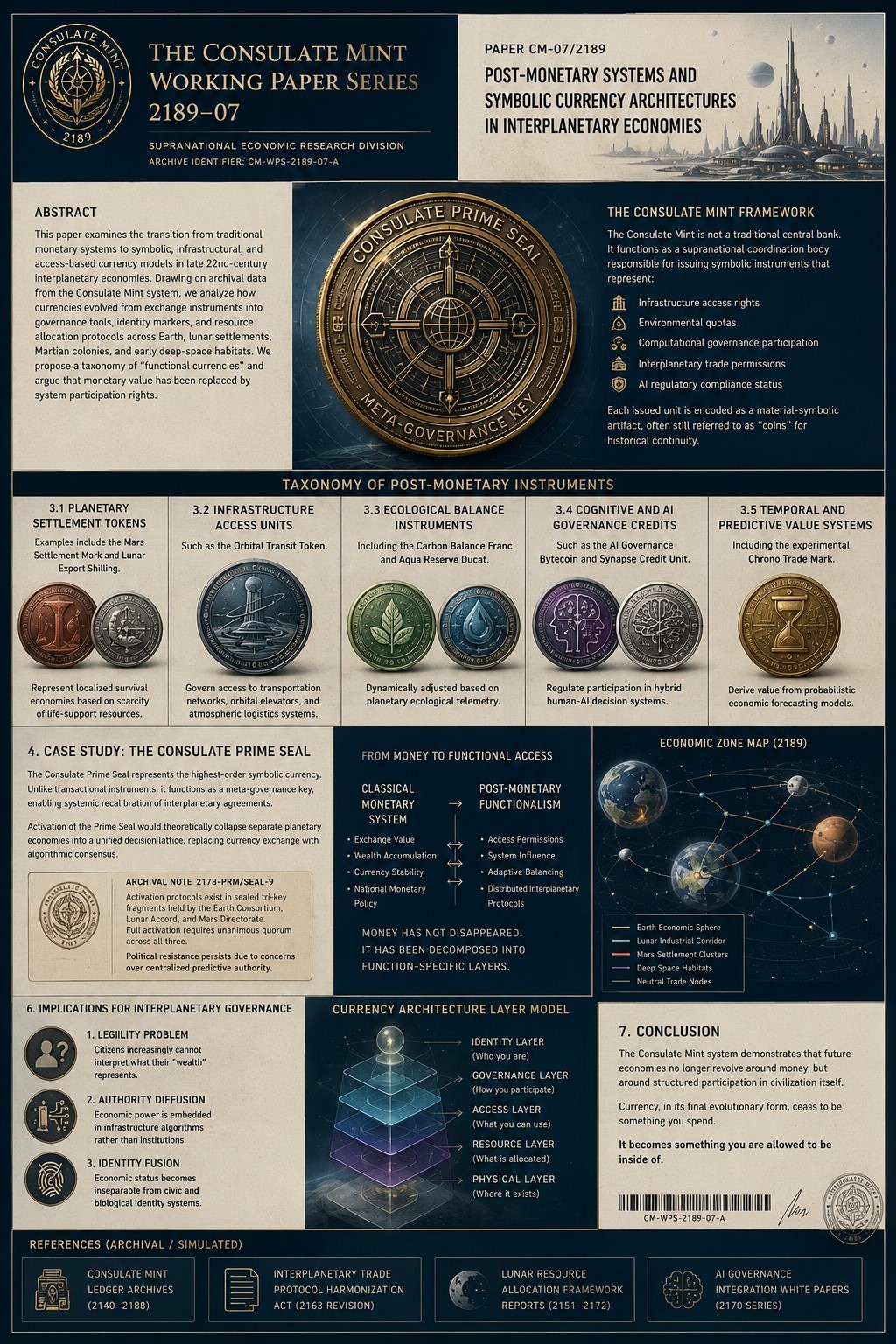
This paper examines the transition from traditional monetary systems to symbolic, infrastructural, and access-based currency models in late 22nd-century interplanetary economies. Drawing on archival data from the Consulate Mint system, we analyze how currencies evolved from exchange instruments into governance tools, identity markers, and resource allocation protocols across Earth, lunar settlements, Martian colonies, and early deep-space habitats. We propose a taxonomy of “functional currencies” and argue that monetary value has been replaced by system participation rights.
1. Introduction
Classical economic theory defined currency as a medium of exchange, a unit of account, and a store of value. However, post-planetary expansion rendered these definitions insufficient.
By 2100 CE, the fragmentation of economic zones across Earth, lunar industry corridors, and Martian settlement clusters forced the emergence of multi-layered economic protocols. By 2150, the concept of “money” had begun dissolving into what Consulate economists now classify as access tokens.
These tokens are no longer primarily exchangeable; they are permissions embedded into governance systems.
2. The Consulate Mint Framework
The Consulate Mint is not a traditional central bank. It functions as a supranational coordination body responsible for issuing symbolic instruments that represent:
- Infrastructure access rights
- Environmental quotas
- Computational governance participation
- Interplanetary trade permissions
- AI regulatory compliance status
Each issued unit is encoded as a material-symbolic artifact, often still referred to as “coins” for historical continuity.
3. Taxonomy of Post-Monetary Instruments
We classify Consulate-issued instruments into five categories:
3.1 Planetary Settlement Tokens
Examples include the Mars Settlement Mark and Lunar Export Shilling.
These represent localized survival economies based on scarcity of life-support resources.
3.2 Infrastructure Access Units
Such as the Orbital Transit Token.
These govern access to transportation networks, orbital elevators, and atmospheric logistics systems.
3.3 Ecological Balance Instruments
Including the Carbon Balance Franc and Aqua Reserve Ducat.
These are dynamically adjusted based on planetary ecological telemetry.
3.4 Cognitive and AI Governance Credits
Such as the AI Governance Bytecoin and Synapse Credit Unit.
These regulate participation in hybrid human-AI decision systems.
3.5 Temporal and Predictive Value Systems
Including the experimental Chrono Trade Mark.
These instruments derive value from probabilistic economic forecasting models.
4. Case Study: The Consulate Prime Seal
The Consulate Prime Seal represents the highest-order symbolic currency. Unlike transactional instruments, it functions as a meta-governance key, enabling systemic recalibration of interplanetary agreements.
Activation of the Prime Seal would theoretically collapse separate planetary economies into a unified decision lattice, replacing currency exchange with algorithmic consensus.
However, archival notes indicate persistent political resistance due to concerns over centralized predictive authority.
5. Discussion: The Collapse of Monetary Meaning
Our findings suggest that “money” has not disappeared but has been decomposed into function-specific layers:
- Exchange value → replaced by access permissions
- Wealth accumulation → replaced by system influence
- Currency stability → replaced by adaptive algorithmic balancing
- National monetary policy → replaced by distributed interplanetary protocols
This shift represents what we define as Post-Monetary Functionalism.
6. Implications for Interplanetary Governance
The transition to symbolic currency systems introduces three key challenges:
- Legibility Problem – Citizens increasingly cannot interpret what their “wealth” represents.
- Authority Diffusion – Economic power is embedded in infrastructure algorithms rather than institutions.
- Identity Fusion – Economic status becomes inseparable from civic and biological identity systems.
7. Conclusion
The Consulate Mint system demonstrates that future economies no longer revolve around money, but around structured participation in civilization itself.
Currency, in its final evolutionary form, ceases to be something you spend.
It becomes something you are allowed to be inside of.
References (Archival / Simulated)
- Consulate Mint Ledger Archives (2140–2188)
- Interplanetary Trade Protocol Harmonization Act (2163 Revision)
- Lunar Resource Allocation Framework Reports (2151–2172)
- AI Governance Integration White Papers (2170 Series)
Blog call centre spoof Castle Changing of the Guard dea Dealing with fake calls drink England England vs Argentina 7/15/2026 food football hacking Heart Heart Foundation Heart process Horse Races Invest IOU kebabs Lord Sugar medication poker Premier League 26/27 Python Python Horse Program Python Horse Tracker royal landmarks UK Scones secret soccer Thames riverside walk Thca Three Stooges Tunnels Win Windsor Windsor castle blog Windsor Drinks Windsor Great Park Windsor Horse Races Windsor hungry Windsor tourism Windsor travel blog World Cup World Cup 2026
-
The Consulate Mint Working Paper Series (2189–07)
By 2100 CE, the fragmentation of economic zones across Earth, lunar industry corridors, and Martian settlement clusters forced the emergence of multi-layered economic protocols. By 2150, the concept of “money” had begun dissolving into what Consulate economists now classify as access tokens.

Leave a Reply
You must be logged in to post a comment.