By Simon Ben Gemmill
A concept for combining renewable energy with careful, multi-stage water treatment to support cleaner rivers, coasts and resilient local water supplies across the British Isles.
A vision for cleaner water
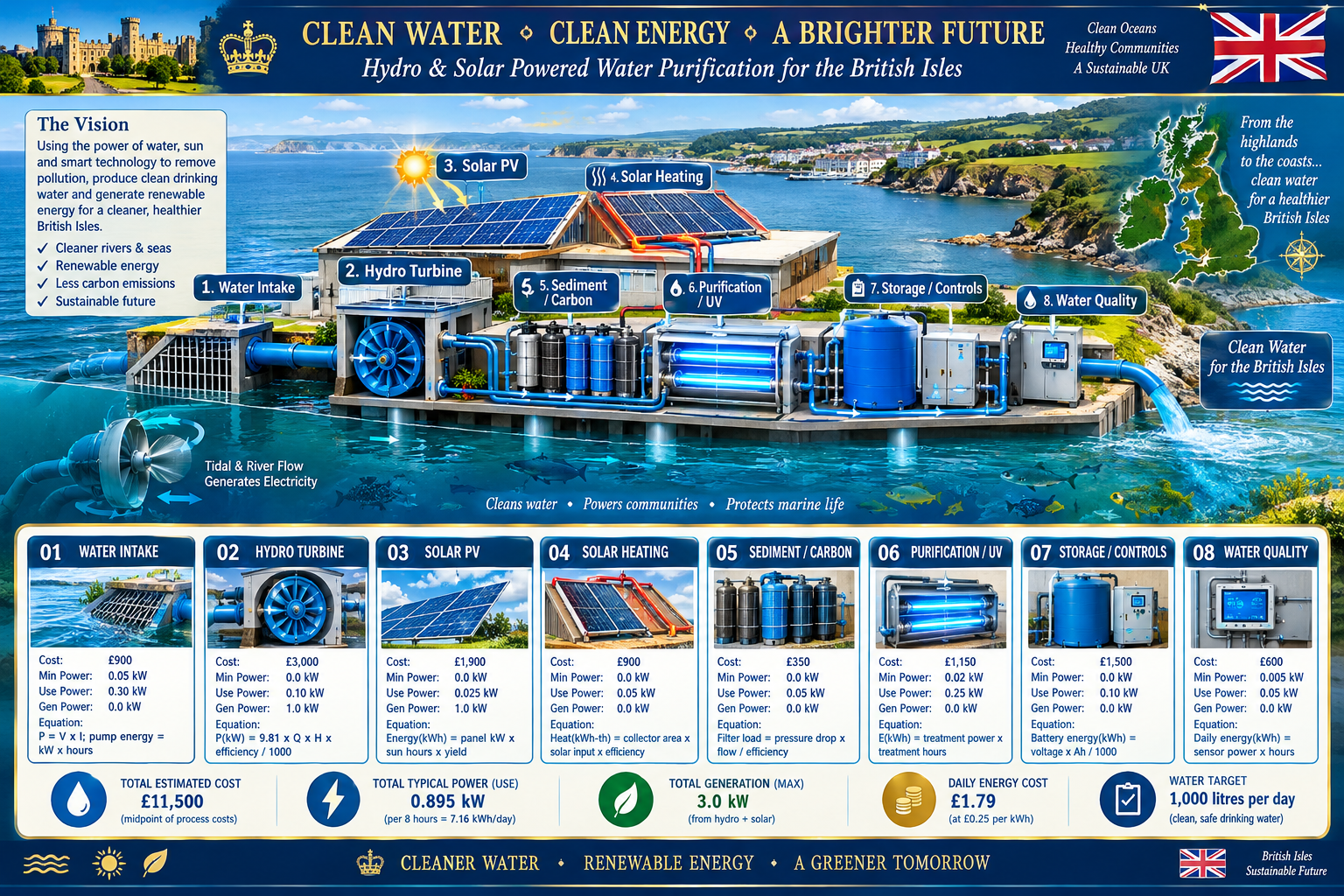
Water is essential to every community, and protecting it begins with healthy catchments, cleaner rivers and coastlines, and treatment systems designed for the water they receive. The idea shown in the accompanying illustration is to bring together water intake, renewable electricity, filtration, disinfection, storage and continuous quality monitoring in one coordinated system.
This is a design concept rather than a tested engineering proposal. A real installation would need a site-specific assessment of water source, flow, head, ecology, flood risk, energy yield, treatment requirements, planning and environmental permissions.
“It is always better to protect water from contamination than to treat it after it has been contaminated.”
— Summary of the source-protection principle described by the Drinking Water Inspectorate (DWI), Manual on Treatment for Small Water Supply Systems.
Eight stages from intake to monitoring
1. Water intake
A screened intake can reduce the entry of leaves and larger debris.
{"id":"01","name":"WATER INTAKE","cost":900,"min_kw":0.05,"use_kw":0.30,"gen_kw":0.0}
Equation: P = V x I; pump energy = kW x hours
The intake must be designed to protect aquatic life and avoid damaging habitats, while abstraction must comply with the relevant local rules and permissions.
2. Hydro turbine
Where a suitable, lawful water flow and elevation difference exist, a small hydro turbine may recover some energy. Output depends on flow, head and efficiency; a turbine does not create energy from nothing, and pumping water uphill can use more energy than is later recovered.
{"id":"02","name":"HYDRO TURBINE","cost":3000,"min_kw":0.0,"use_kw":0.10,"gen_kw":1.0}
Equation: P(kW) = 9.81 x Q x H x efficiency / 1000
3. Solar photovoltaic panels
Solar PV can supply electricity for pumps, sensors and control equipment when sunlight is available. Actual generation depends on panel capacity, orientation, weather, season and system losses; batteries or grid backup may be needed.
{"id":"03","name":"SOLAR PV","cost":1900,"min_kw":0.0,"use_kw":0.025,"gen_kw":1.0}
Equation: Energy(kWh) = panel kW x sun hours x yield
4. Solar heating
Solar thermal collectors can provide heat for suitable processes, but heat is not a substitute for a validated disinfection process. The plant should use thermal energy only where the treatment design calls for it.
{"id":"04","name":"SOLAR HEATING","cost":900,"min_kw":0.0,"use_kw":0.05,"gen_kw":0.0}
Equation: Heat(kWh-th) = collector area x solar input x efficiency
5. Sediment and activated-carbon filtration
Pre-filtration can remove suspended particles, while activated carbon can reduce certain chemicals, tastes and odours. No single filter removes every contaminant, and media must be selected and replaced based on testing and manufacturer guidance.
{"id":"05","name":"SEDIMENT / CARBON","cost":350,"min_kw":0.0,"use_kw":0.05,"gen_kw":0.0}
Equation: Filter load = pressure drop x flow / efficiency
6. Purification and UV disinfection
Ultraviolet treatment can inactivate susceptible microorganisms when the water and equipment meet the required operating conditions. UV does not remove all dissolved chemicals and generally leaves no lasting disinfectant residual, so a qualified designer must determine whether additional treatment is needed.
{"id":"06","name":"PURIFICATION / UV","cost":1150,"min_kw":0.02,"use_kw":0.25,"gen_kw":0.0}
Equation: E(kWh) = treatment power x treatment hours
7. Storage and controls
Covered, hygienic storage can balance supply and demand. Sensors, alarms and maintenance records help operators detect faults and keep treatment stages working within their validated limits.
{"id":"07","name":"STORAGE / CONTROLS","cost":1500,"min_kw":0.0,"use_kw":0.10,"gen_kw":0.0}
Equation: Battery energy(kWh) = voltage x Ah / 1000
8. Water-quality monitoring
Monitoring may include turbidity, pH, flow and other parameters selected by a water-quality specialist. Laboratory analysis and ongoing compliance checks are essential: a display reading alone cannot certify water as safe to drink.
{"id":"08","name":"WATER QUALITY","cost":600,"min_kw":0.005,"use_kw":0.05,"gen_kw":0.0}
Equation: Daily energy(kWh) = sensor power x hours
What do the illustrative figures mean?
The accompanying concept graphic uses an illustrative equipment-cost total of £10,300 and a combined typical electrical use of about 0.925 kW for the listed loads. At eight hours, that is approximately 7.40 kWh per day; at an assumed electricity price of £0.25/kWh, the simple energy-cost estimate is £1.85 per day.
These are arithmetic examples based on the supplied figures, not supplier quotations or a feasibility study. The original Python settings and process table are reproduced in relevant excerpts below so readers can inspect the assumptions. The estimated 1,000 litres per day is a target, not a proven output. Likewise, the listed hydro and solar “maximum generation” figures should not be added as guaranteed continuous output: solar output varies, and hydro output depends on measured site conditions. A proper design must balance generation, storage, demand and treatment reliability.
Protecting the British Isles’ water environment
A plant should complement—not replace—catchment protection, pollution prevention, responsible abstraction and established public water services. Any scheme proposing to supply drinking water must meet applicable drinking-water standards and be designed, validated and operated by competent professionals. In England, relevant permissions may include abstraction and environmental permits, depending on the project.
“Effective treatment … does not rely on one key stage.”
— The multi-barrier approach described in the Drinking Water Inspectorate Treatment Guide.
Sources and further reading
- Water UK — Drinking water: overview of UK drinking-water sources, treatment and monitoring.
- Drinking Water Inspectorate — Treatment Guide: treatment selection and the multi-barrier approach.
- Drinking Water Inspectorate — Manual on Treatment for Small Water Supply Systems: source protection, treatment stages and the need for site assessment.
- Environment Agency — Water recycling for public water supply: resilience, regulation and environmental considerations.
Editorial note: This article describes an illustrative concept for public discussion. Costs, energy ratings and daily water target are estimates supplied for the concept and have not been independently verified. It is not a construction specification or confirmation that treated water is potable.
Copyright © Simon Ben Gemmill. All rights reserved.
 0

 20
 20








Leave a Reply
You must be logged in to post a comment.