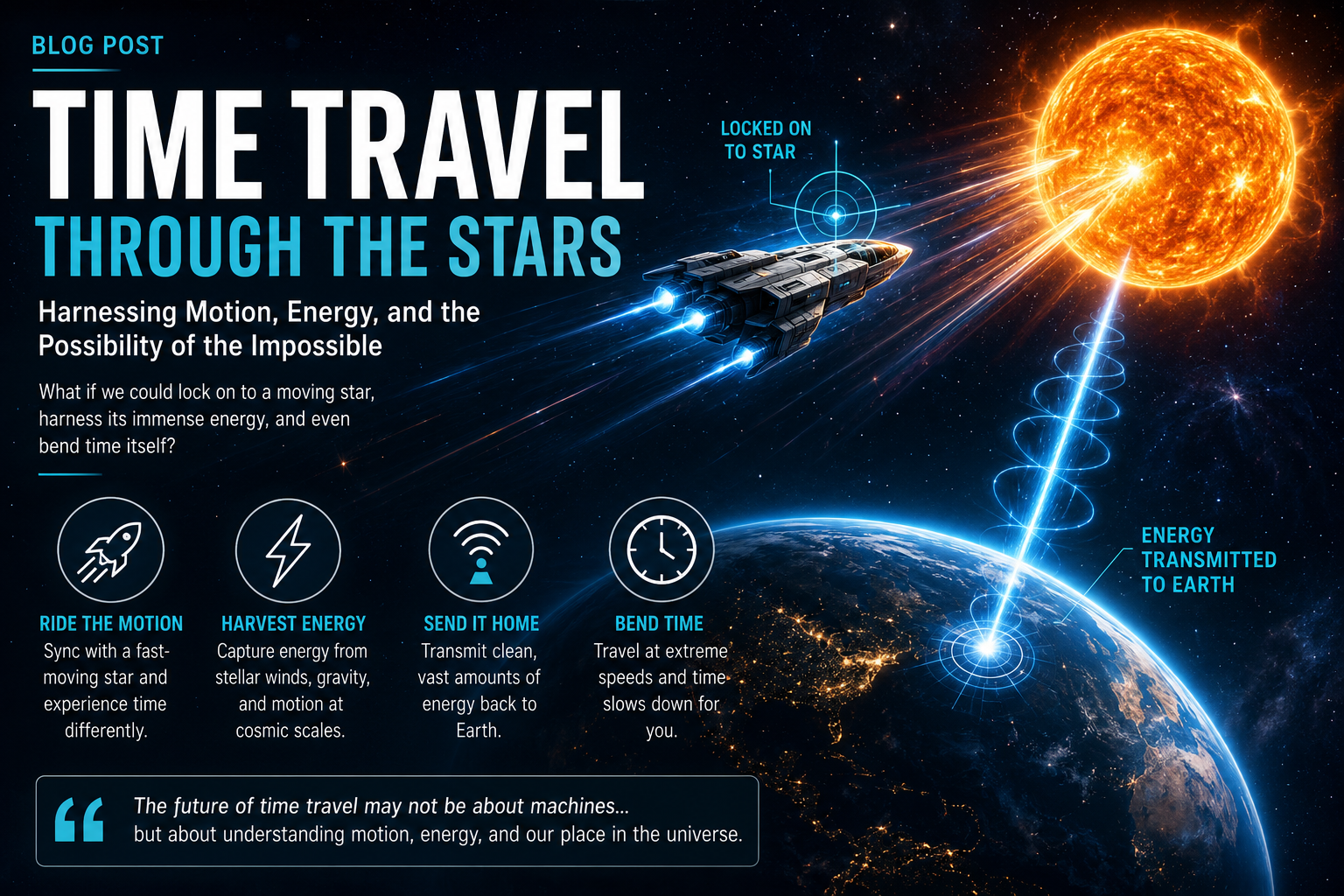
Desde los clásicos de la ciencia ficción hasta la física de vanguardia, el concepto de desplazarse por el paisaje temporal ha cautivado durante mucho tiempo nuestra imaginación. Si bien la creencia popular a menudo apunta a DeLorean, cabinas de policía azules o agujeros de gusano microscópicos, existe una posibilidad más profunda: ¿y si la clave para viajar en el tiempo no estuviera oculta en una máquina independiente, sino en el macro-movimiento del propio cosmos? ¿Y si una civilización suficientemente avanzada pudiera "sintonizar" una estrella en movimiento o una anomalía cósmica, aprovechando su inmensa energía cinética y gravitacional para deformar el tejido del espacio-tiempo?
To understand how the universe’s natural motion could become a literal time machine, we have to look at the intersection of theoretical physics and speculative fiction.
1. Frame-Dragging and Rotating Universes
In physics, mass doesn’t just sit in space—when it spins, it actively drags space-time along with it, a proven phenomenon known as frame-dragging (or the Lense-Thirring effect). If you scale this up to cosmic proportions, motion becomes a doorway to the past.
The Gödel Metric (The Spinning Cosmos): In 1949, mathematician Kurt Gödel solved Einstein’s field equations by imagining a universe that was uniformly rotating. In Gödel’s universe, the rotation drags space-time so severely that it creates Closed Timelike Curves (CTCs)—paths where a ship, simply by flying in a massive circle, could catch up to its own past. You wouldn’t need a warp drive; the natural rotation of the universe would do the time-bending for you.
The Tipler Cylinder (The Infinite Star): Physicist Frank Tipler took this a step further. Instead of a whole universe, he calculated that if you took a dense star (like a neutron star), stretched it into an infinitely long cylinder, and spun it at nearly the speed of light, it would create the same CTCs. A spaceship locking onto this spinning column and spiraling around it would emerge in a different era.
2. Cosmic Strings and Relativistic Footprints
In sci-fi, we often think of space as smooth, but cutting-edge astrophysics suggests it might have literal cracks and seams.
Gott Time Machines: Physicist J. Richard Gott discovered that cosmic strings—hypothetical, ultra-dense, microscopic defects left over from the Big Birth of the universe—could manipulate time through sheer velocity. If two parallel cosmic strings fly past each other at relativistic speeds (near the speed of light), they bend space-time so acutely that a spacecraft tracing a loop around the moving pair would return to its starting point before it ever left.
3. The Sci-Fi Precedents: Navigating the Gravitational Wake
Science fiction has frequently anticipated this idea of piggybacking on cosmic motion rather than building a standalone generator.
The Slingshot Effect (Star Trek): In Star Trek IV: The Voyage Home, the crew doesn’t use a specialized time displacement device. Instead, they utilize the “slingshot effect”—accelerating a heavy ship toward a high-gravity star and using its precise orbital motion and gravitational well to slingshot backward through time.
El Anillo y la Navegación por Singularidad: La ciencia ficción dura a menudo imagina anclar una nave al horizonte de sucesos de un agujero negro de Kerr (en rotación) que gira rápidamente. Al “anclarse” a la ergosfera —la región justo fuera del horizonte donde el espacio-tiempo es arrastrado más rápido que la luz—, una nave puede explotar la dilatación gravitacional del tiempo para saltar siglos hacia el futuro en cuestión de horas.
En última instancia, si el viaje en el tiempo llega a realizarse, puede que no se parezca a una máquina haciendo sonar sus engranajes en un laboratorio. Se parecerá a un sistema de navegación estelar, trazando un rumbo en la corriente de una estrella en movimiento, cabalgando las ondas gravitacionales de un universo que ya está haciendo el trabajo pesado.
El viaje en el tiempo ha fascinado a la humanidad durante siglos. Desde los clásicos de la ciencia ficción hasta las teorías físicas de vanguardia, la idea de moverse a través del tiempo —ya sea hacia el futuro o hacia el pasado— captura nuestra imaginación. Pero, ¿y si la clave del viaje en el tiempo no está oculta en máquinas o agujeros de gusano, sino en el movimiento del propio universo? ¿Y si pudiéramos “anclarnos” a una estrella en movimiento y aprovechar su inmensa energía para doblar el tiempo?
Exploremos este concepto audaz e intrigante.
El Universo Siempre Está en Movimiento
Nada en el universo está verdaderamente quieto. Los planetas orbitan estrellas, las estrellas orbitan galaxias y las propias galaxias se desplazan por el cosmos. Algunas estrellas viajan a velocidades increíbles —cientos de kilómetros por segundo—, transportando consigo enormes cantidades de energía cinética.
Según la física moderna, el movimiento y el tiempo están profundamente conectados. Cuanto más rápido se mueve un objeto, más lento pasa el tiempo en relación con un observador estacionario. Esto se conoce como dilatación del tiempo, un principio de la teoría de la relatividad de Einstein.
En términos sencillos:
Muévete lo suficientemente rápido y el tiempo mismo comenzará a cambiar.
Anclarse a una Estrella en Movimiento
Imaginemos una tecnología futura capaz de identificar una estrella en rápido movimiento y sincronizarse con su trayectoria, un proceso que podríamos llamar “anclaje estelar”.
Esto no significaría unirse físicamente a la estrella (lo cual sería imposible debido a las temperaturas y la radiación extremas), sino más bien:
- Igualar su velocidad utilizando propulsión avanzada
- Alinear una nave espacial o un sistema de energía dentro de su influencia gravitacional
- Utilizar el movimiento de la estrella como marco de referencia
Al “cabalgando” efectivamente junto a una estrella de alta velocidad, una nave espacial podría entrar en una región donde el tiempo se comporta de manera diferente en comparación con la Tierra.
Cosechar Energía del Movimiento
Una estrella en movimiento contiene una enorme energía cinética. Si pudiéramos desarrollar una forma de extraer incluso una fracción de esta energía, podría alimentar sistemas avanzados mucho más allá de todo lo que entendemos actualmente.
Los métodos potenciales podrían incluir:
- Captura de energía gravitacional: utilizando las fuerzas de marea creadas por el movimiento de la estrella
- Cosecha de viento estelar: recolectando partículas cargadas emitidas por la estrella
- Conversión de energía relativista: convirtiendo el movimiento en energía utilizable a través de mecanismos de física avanzada
This energy could then be transmitted back to Earth or used to power a time-altering system.
Sending Energy Back to Earth
Transmitting energy across interstellar distances is a major challenge, but not impossible in theory. Concepts include:
- Directed energy beams (like highly focused lasers)
- Quantum-linked energy transfer (a speculative future technology)
- Wave-based transmission using electromagnetic fields
If successful, Earth could receive energy generated from a star’s motion—essentially tapping into the dynamics of the universe itself.
The Time Travel Effect
So where does time travel come in?
By moving at extreme speeds alongside a star, a spacecraft would experience time more slowly than observers on Earth. For example:
- A crew might experience only a few years
- Meanwhile, decades—or even centuries—could pass on Earth
This creates a one-way form of time travel into the future.
Time Travel Through the Stars
Harnessing Motion, Energy, and the Possibility of the Impossible
El Universo Siempre Está en Movimiento
Nothing in the universe is truly still. Planets orbit stars, stars orbit galaxies, and galaxies drift through space. Motion and time are deeply connected. The faster you move, the slower time passes relative to others — a concept known as time dilation.
Anclarse a una Estrella en Movimiento
Imagine matching the velocity of a fast-moving star. Not attaching to it, but synchronising with its motion. By aligning with its speed and gravitational influence, we could enter a new frame of time itself.
Harvesting Energy
A moving star carries enormous energy. Future technology might capture this through stellar winds, gravitational forces, or advanced energy conversion systems.
Sending Energy Back to Earth
Energy could be transmitted using focused beams or advanced electromagnetic systems. Earth could tap into the movement of the cosmos itself.
The Time Travel Effect
Travelling alongside a star at extreme speeds would slow time for the traveller. Years for them could mean decades on Earth — a real form of time travel into the future.
Challenges
Extreme heat, radiation, speed, and engineering limitations make this idea theoretical. But history shows today’s imagination can become tomorrow’s reality.
A Glimpse Into the Future
Perhaps one day humanity will ride the motion of stars themselves, bending time through understanding physics rather than breaking it.
Blog suplantación de centralita Castillo Cambio de guardia dea Cómo lidiar con llamadas falsas bebida Inglaterra Inglaterra vs Argentina 15/07/2026 comida fútbol hacking Corazón Fundación del Corazón Proceso del corazón Carreras de caballos Invertir Pagaré kebabs Lord Sugar medicamento póker Premier League 26/27 Python Programa de caballos de Python Rastreador de Caballos de Python monumentos reales Reino Unido Scones secreto fútbol Paseo por la ribera del Támesis Thca Los Tres Chiflados Túneles Ganar Windsor blog del castillo de Windsor Bebidas Windsor Parque Real de Windsor Carreras de Caballos de Windsor Windsor hambriento turismo en Windsor blog de viajes de Windsor Copa del Mundo Copa del Mundo 2026
Posts
- Amazon Book (January 28, 2026)
- Windsor Castle (January 29, 2026)
- Food & Drinks (February 24, 2026)
- Windsor Night-Life (February 27, 2026)
- What Windsor is Like (February 27, 2026)
- Windsor Arts Centre (February 27, 2026)
- Kings and Queens Who Lived at Windsor Castle (March 13, 2026)
- Ghost Stories – Windsor Castle 👑 (March 13, 2026)
- How to Buy Windsor Castle Tickets Online (Official Guide) (March 14, 2026)
- Royal Events (April 10, 2026)
- 🏰 20 Surprising Facts About Windsor Castle (April 15, 2026)
- Windsor Castle Visitor Guide (2026): Tickets, Tips & Hidden Gems (April 16, 2026)
- AI Conservatory Builder Dashboard (HTML + JavaScript) – Full Smart Cost Simulator (April 17, 2026)
- 🌿 Finding Calm in a Noisy World: A Look at Mindfulness and Meditation by Simon Gemmill (April 18, 2026)
- Title: Chuckles & His Brother Skint – Piggy Problems (April 19, 2026)
- Discover Royal Majesty at Windsor Castle (April 21, 2026)
- Tarot Cards: Beginners Help Guide (Statoshi.co.uk) Paperback – 15 Feb. 2023 (April 21, 2026)
- Windsor Castle Quiz – Test Your Knowledge of Britain’s Royal Landmark (April 22, 2026)
- Poker Mastery by Simon Gemmill – A Practical Guide to Winning Play! (April 24, 2026)
- Saving Swans on the River Thames (April 25, 2026)
- Eton & Windsor Bridge Guide: Things to Do, Eton College, Shops, Food and Riverside Walks (April 25, 2026)
- Wind in the Willows Chaos Comedy – Episode Player (April 26, 2026)
- Explore the Long Walk (April 26, 2026)
- Idiosyncratic sleeping (April 30, 2026)
- World cup email (May 7, 2026)
- HP Sauce (May 7, 2026)
- Wonderful (May 7, 2026)
- Wind in Willows Parody (May 15, 2026)
- The Slow Lane (May 18, 2026)
- England World -Cup Preview (May 18, 2026)
- Windsor Through the Seasons — Where To Eat, Drink Tea & Enjoy Scones (May 19, 2026)
- The Secret Tunnels Beneath (May 19, 2026)
- Investing (May 20, 2026)
- 🏰 What It’s Like to See the Changing of the Guard in Windsor (May 25, 2026)
- 🌍 How Global Tensions Are Affecting Everyday Life in Britain (2026) (May 25, 2026)
- Not Push (May 28, 2026)
- Immune vs Cancer Simulation – Interactive Cellular Battle in HTML5 (May 29, 2026)
- 🐎👑 Stagecoaches and Royal Coaches at Windsor Castle (May 29, 2026)
- 👑 Lost Treasures of Windsor Castle: The Mystery of Missing Royal Artefacts (May 29, 2026)
- Stonehenge Ancient Mystery (May 30, 2026)
- Title: The Case That Should Never Have Happened (May 31, 2026)
- 🧠 Biology Animation: A Living System of Motion, Thought, and Connection (May 31, 2026)
- Toward a Global Framework for Digital Assets: NFTs, Taxation, and Cross-Border Value Exchange (June 1, 2026)
- Why the Royal Family Loves Windsor Castle (June 5, 2026)
- 👑 The Day a Royal Fell Asleep on the Throne (A Completely True…ish Time-Travel Tale) (June 6, 2026)
- The Hillbilly Prophet of Possum Ridge (June 6, 2026)
- Windsor Leisure Centre vs LEGOLAND® Windsor Resort & 2: Legoland Merlin Resort (June 6, 2026)
- 🐎 Windsor Races: Tickets, Food, Betting, Events & Accessibility Guide (2026) (June 7, 2026)
- Unified AI Finance Dashboard with ASCII Character Art Generator | HTML JavaScript Project (June 10, 2026)
- If I Were President of the United States: A Vision for a Fairer Future (June 11, 2026)
- World Cup 2026-Todays Previews & Yesterday Folllowup: (June 12, 2026)
- The Consulate Mint Working Paper Series (2189–07) (June 21, 2026)
- World Cup 2026: Jordan and Panama eliminated as group stage nears conclusion (June 24, 2026)
- Premier League transfer landscape ⚽👇 (June 25, 2026)
- WSOP Poker & Playing In Germany (June 25, 2026)
- 🛡️ The Rise of Smart Anti-Virus Programs: Why Protection Matters More Than Ever – SPAM Removal (June 25, 2026)
- The Backdoor Fortune: Adam’s Python Gamble (June 26, 2026)
- Beware of Scam call centres targeting UK! (June 26, 2026)
- ⚽ World Cup 2026 Round of 32: Stats, Strategy & Key Battles Ahead (June 26, 2026)
- Building a Fully Client-Side NFT Marketplace with Real-Time Simulation and Cloud Sync (June 30, 2026)
- ⚽England vs DR Congo (June 30, 2026)
- ⚽ First Ever FIFA World Cup (1930): History, Winners, Top Scorer & Full Results plus synopsis of current World Cup 20-6 (July 4, 2026)
- 📈 Diversification Strategy UK: How to Build and Protect Wealth in Britain (July 5, 2026)
- Inglaterra debería saber esto (5 de julio de 2026)
- WSOP 2-26 (5 de julio de 2026)
- Entendiendo la Diverticulitis: Qué hacer durante un brote y qué comer. (6 de julio de 2026)
- El Arte de la Pesca: Técnicas, Consejos y la Alegría de un Deporte Pacífico (7 de julio de 2026)
- La Mujer Más Alta del Mundo: Una Historia de Vida Extraordinaria (7 de julio de 2026)
- Arrecifes de Coral y el Costo Oculto del Juego: Belleza, Riesgo y Responsabilidad (9 de julio de 2026)
- Viaje en el Tiempo a Través de las Estrellas: Aprovechando el Movimiento, la Energía y la Posibilidad de lo Imposible (11 de julio de 2026)
- Programa de Simulación de Bolas de Física Caótica<title>Simulación de Bolas de Física Caótica</title> (12 de julio de 2026)
- Un pagaré (abreviatura de "I owe you") es un documento informal y escrito que reconoce una deuda. Típicamente establece la cantidad de dinero o artículos adeudados, identifica al deudor y está firmado, pero generalmente carece de fechas o plazos de pago específicos (15 de julio de 2026)
- Los Tres Chiflados (15 de julio de 2026)
- Argentina vs Inglaterra: Cómo Argentina Intentará Controlar la Semifinal de la Copa del Mundo a Través de la Posesión y el Espacio (15 de julio de 2026)
- THCA +- Reino Unido – ¡Es Hora de Cambiar! (15 de julio de 2026)
- Perdido en la Traducción: Frases Británicas Que Dejan a los Estadounidenses Perplejos (15 de julio de 2026)
- Limones: El Superalimento Amarillo Brillante de la Naturaleza (15 de julio de 2026)
- Fascismo: Una Historia Detallada de sus Orígenes, Ideología, Auge e Impacto Global (16 de julio de 2026)
- Cada Día Es Día de Guerra (Desafortunadamente) (16 de julio de 2026)
- 🦞 Cómo Preparar Bogavante con Salsa de Mantequilla y Ajo y Textura Crujiente (1 de agosto de 2026)
- Vida Moderna en Apartamentos (1 de agosto de 2026)
- 🔥 Seguridad contra Incendios 101: Cómo Prevenir y Extinguir Incendios de Forma Segura (1 de agosto de 2026)
- 🚗 Conduce Seguro, Mantente Seguro: Consejos Esenciales para Cada Viaje (1 de agosto de 2026)
- ⚖️ "Entendiendo los Problemas Legales: Una Guía Sencilla para la Vida Cotidiana" (1 de agosto de 2026)
- ⛽ Repostando tu Coche de Forma Inteligente: Consejos para la Eficiencia de Gasolina y Combustible (1 de agosto de 2026)
- 🌱 Vida Ecológica Fácil: Pequeños Cambios que Tienen un Gran Impacto (1 de agosto de 2026)
- 💻 Dominando el Trabajo Remoto: Consejos de Productividad para Oficinas en Casa (1 de agosto de 2026)
- 💻 Dominando el Trabajo Remoto: Consejos de Productividad para Oficinas en Casa (1 de agosto de 2026)
- 💰 Asuntos de Dinero: Formas Inteligentes de Ahorrar y Hacer Crecer tu Patrimonio (1 de agosto de 2026)
- 🌍 ✈️ Viajar a Windsor desde EE. UU.: Una Aventura Real Británica con British Airways (1 de agosto de 2026)
- 🧠 Mantente Positivo: Construyendo una Mentalidad Fuerte para la Vida Cotidiana (1 de agosto de 2026)
- How an MP’s use of hospitality and hospice support works using real-world organizational examples and official transparency records: (August 3, 2026)
- The Wonderful, Slightly Ridiculous Life Factory (August 3, 2026)
- Premier League Matchweek 1 Opening Fixtures (August 3, 2026)
Páginas
- Política de Privacidad (28 de enero de 2026)
- Términos de Servicio (14 de febrero de 2026)
- Blog del Castillo (18 de marzo de 2026)
- Tienda (20 de marzo de 2026)
- Carrito (12 de abril de 2026)
- Finalizar compra (12 de abril de 2026)
- Mi cuenta (12 de abril de 2026)
- Política de cookies (12 de abril de 2026)
- Coche (7 de mayo de 2026)
- Política de reembolsos y devoluciones (7 de mayo de 2026)
- Revisa tu pedido (11 de junio de 2026)
- Revisa tu pedido (11 de junio de 2026)
- Revisa tu pedido (11 de junio de 2026)
- ¡Hola!
- Algo (13 de julio de 2026)
Productos
- Guía del Castillo de Windsor en rústica (12 de abril de 2026)
- Mindfulness y meditación: Una guía práctica para la calma interior, la concentración y el alivio del estrés (2 de mayo de 2026)
- Tarot: Guía de ayuda para principiantes (2 de mayo de 2026)
- Guía rápida y fácil de póker: Domina la estrategia de Texas Hold’em para principiantes y jugadores avanzados (2 de mayo de 2026)
- Clockers: SAS in Time – Un thriller de viajes en el tiempo militar clasificado | por Simon Ben Gemmill (2 de mayo de 2026)
- Libro para colorear Castillos y Dragones – Arte de fantasía para niños y adultos | por Simon Gemmill (2 de mayo de 2026)

Leave a Reply
You must be logged in to post a comment.