Fictional research dossier: This is a science-fiction mystery built around real planetary-science concepts. The Asterion mission, Mole-7 rover, researchers, measurements and discoveries described below are invented. They are not reports of a real Mars mission.
What if a robotic expedition entered a Martian cave and found a signal that appeared to predict the rover’s movements? The Caves Beneath Mars is a cinematic research mystery about lava tubes, scientific uncertainty and a final transmission that cannot be explained by the mission team.

Abstract: The Asterion mission
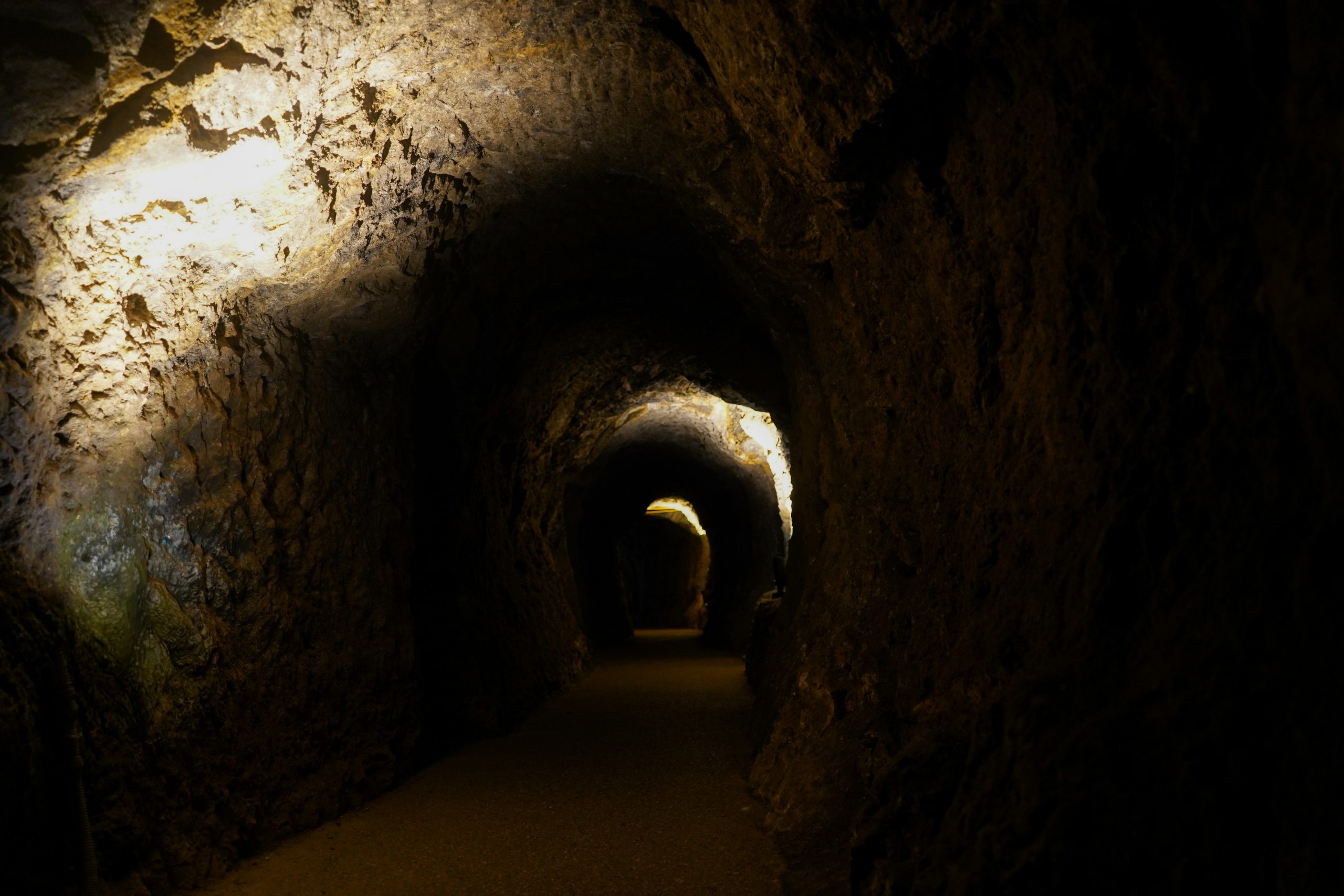
In the fictional year 2042, an international robotic expedition explores a suspected lava tube beneath the western flank of Arsia Mons. The cave is selected because a thick roof could offer protection from some surface hazards and preserve clues to Mars’s geological history.
On the third day underground, two receivers record a repeating electromagnetic signal. A mapping robot named Mole-7 then detects unusually regular depressions in the rock. When its camera records an image with a timestamp several minutes ahead of the mission clock, the team must distinguish equipment faults from a genuinely unexplained observation.
Research question and hypotheses
Primary question: Could the unexplained signal and geometric formations inside a Martian lava tube be accounted for by known geological and physical processes?
- H1 — Geology: the formations are natural products of volcanic activity or erosion.
- H2 — Instrument fault: a sensor, clock or software error has corrupted the observations.
- H3 — Interference: the signal comes from the rover’s electronics or radio environment.
- H4 — Unknown natural process: repeat measurements reveal an unusual but natural mechanism.
- H5 — Artificial origin: the geometry and material evidence indicate deliberate construction. This is a hypothesis to test, not an assumed conclusion.
Why investigate caves on Mars?
Lava tubes form when the surface of a flowing lava stream cools while molten material continues moving below it. Once the lava drains away, an underground passage can remain. Planetary scientists study possible caves because they may reveal volcanic history and could provide a more sheltered environment for future exploration.
Mineral deposits and evidence of past water-rock interactions could help researchers assess whether ancient Martian environments were once habitable. Such clues would not, by themselves, prove that life existed.

Methodology: Mole-7’s underground survey
The fictional Mole-7 rover carries a lidar mapper, cameras, two independent radio-frequency receivers, temperature and radiation sensors, and a mineral-analysis instrument. The mission protocol requires calibration before and after each survey, repeated scans from different angles, preservation of raw data and independent checks of all timestamps.
- Map the cave: build a three-dimensional model of the passage and chamber.
- Analyse the signal: compare both receivers’ records with equipment activity and known transmissions.
- Measure the environment: record temperature, radiation and mineral composition at multiple locations.
- Verify independently: repeat scans and compare original sensor data before drawing conclusions.
Invented findings: the signal and the chamber
All results below are fictional story data. During the imagined survey, the cave extends 1.8 kilometres from its entrance. The temperature varies less than expected between several locations, and mineral deposits warrant a closer examination for possible ancient water-rock interactions.
At 03:17 mission time, both receivers detect a narrow-band signal that repeats every 17 seconds. The fictional readings rise when Mole-7 enters a chamber containing twelve evenly spaced depressions around a central rock column. Their spacing varies by less than 1.5 per cent in the initial map—an intriguing observation, but not proof of artificial construction.
Graph: the fictional signal readings
The graph below shows invented signal-strength values across six observation windows. Units are arbitrary and the numbers have been created for this story; they are not real mission telemetry.
The timestamp that should not exist
At 03:42, Mole-7 transmits an image labelled 03:47. It appears to show tracks the rover has not yet made. The team checks clock drift, buffered data, software corruption and image metadata. The checksum is valid, but the available logs do not resolve every discrepancy.
During the next survey, a lidar map reveals a narrow opening behind the central column that was absent from previous scans. Mole-7 sends a final data packet containing a map of the opening and an unidentified rectangular object. Contact is lost. The signal continues for exactly 17 seconds, then stops.
Interpretation: what might explain the anomaly?
| Explanation | What supports it | What remains unresolved |
|---|---|---|
| Sensor or software fault | Missing lidar returns and conflicting timestamps | Not every observation has been reconciled |
| Radio propagation or interference | Signal strength changes inside the chamber | Does not fully explain the image sequence |
| Natural geological structure | Volcanic processes can create regular formations | The chamber is not fully mapped |
| Unknown phenomenon | Several records remain unexplained in the story | No verified evidence establishes a new physical process |
Interim conclusion: the fictional evidence is inconclusive. The team has not proved that the formations are artificial, that life exists on Mars, or that known physics has been violated. An unexplained observation is a reason for further testing, not proof of an extraordinary claim.
Proposed follow-up: Asterion II
A second fictional mission would use two independently designed mapping robots, separate timing systems, a portable radio-frequency analyser, a robotic sampling arm and a tethered communications relay. Researchers would pre-register expected signal characteristics and ask an independent team to analyse the raw data without being told which observations are considered mysterious.
Limitations
- The robot loses contact before the chamber can be fully surveyed.
- Sensor faults, clock errors and radio interference remain plausible.
- The final image and its timestamp cannot be independently verified.
- No physical samples are collected from the unidentified object.
- The fictional study provides no verified evidence of ancient or present-day life.
Conclusion: a scientific mystery
The Caves Beneath Mars combines real planetary-science concepts with invented research results. Its central question is not whether the cave contains alien technology, but how a careful team should respond when measurements do not fit its current explanation.
“We designed this mission to discover what the cave was made of. We may have to return to find out what made it.”
The story ends before the next expedition launches. The cave remains unexplored, the signal unexplained, and the evidence open to testing.
Further reading: real science behind the fiction
- NASA — Mars exploration and planetary science
- US Geological Survey — geology and volcanic processes
- NASA Solar System Exploration — Mars overview
Image credits: Nicolas Lobos, Suganth and Yosuke Ota via Unsplash; photographer profile links are provided beneath each image. Images are illustrative references and are not presented as real photographs of Martian caves.
Prepared for WindsorCastle.info. Fictional research and film concept; all mission data and discoveries are invented.