Could artificial intelligence predict the future? AI can analyse enormous quantities of information, identify patterns and build computer simulations of possible outcomes. But forecasting a possible future is very different from actually knowing what will happen.
Could AI Predict the Future?
Imagine asking a powerful computer: “What will the world look like tomorrow?” An AI system could examine weather, economic activity, scientific research, transport, population changes, technology and human behaviour, then calculate the probabilities of different outcomes.
AI can model possible futures without travelling into the future.
How Could AI Make Predictions?
AI systems learn patterns from large datasets. Depending on the problem, they can use historical weather information, economic data, satellite observations, energy consumption, population statistics, scientific measurements and previous human behaviour to produce forecasts.
The important word is probability. A responsible AI forecast should not pretend that an uncertain result is a certainty. Instead, it can show which outcomes appear more likely based on the information and assumptions available.
The Future as a Computer Simulation
One fascinating possibility is that AI could construct simulations containing many possible futures. A present-day situation could branch into several scenarios: economic growth, technological change, environmental disruption, scientific discovery or an unexpected event. Each scenario could then branch again.
This does not mean the computer has travelled through time. It means that the computer has created mathematical possibilities about what could happen next.
Governments Already Explore Future Scenarios
Future scenarios are already used in serious research and policymaking. The UK Government Office for Science AI Scenarios 2030 examines possible ways AI could develop and affect society, security, geopolitics and the economy. The OECD has also published work exploring possible AI trajectories through 2030.
These scenarios are not guaranteed predictions. Their purpose is to help people think about different possible futures and prepare for uncertainty.
Why Can’t AI Simply See the Future?
The future contains information that does not yet exist. New inventions, scientific discoveries, political decisions, natural events and human choices can all change what happens next.
Complex systems can also be extremely sensitive to small changes. A tiny difference in the starting conditions can eventually produce a very different result. This is one reason why long-range forecasting can become increasingly uncertain.
Research in Nature Computational Science has considered fundamental limits of prediction, including the difficulty of making reliable long-term predictions in complex social systems.
Prediction Is Not Time Travel
This is where artificial intelligence becomes particularly interesting for the study of time travel.
Computational time travel: a computer uses present information to simulate possible futures.
Physical time travel: a person or object actually experiences a different passage of time because of physical processes such as relativistic time dilation.
NASA explains that Einstein’s theory of relativity leads to measurable effects in which time passes differently for observers moving at different speeds. That is a physics question rather than an AI forecasting problem.
Could AI Calculate Thousands of Possible Futures?
Imagine an AI system producing thousands of simulated outcomes. One future might be assigned a 45% probability, another 30%, another 15%, with the remaining possibilities making up the rest.
The AI would not be saying that the 45% future definitely happens. It would be saying that, under the model’s assumptions, that outcome appears more likely than the alternatives.
Could AI Predict Its Own Future?
AI can also be used to examine possible futures for AI itself. Research organisations can construct different scenarios for technological development, economic effects, regulation and adoption.
This creates an intriguing feedback loop: AI helps predict technological change, technological change improves AI, and improved AI creates new forecasts.
The Future Is Still Unwritten
Artificial intelligence may become extraordinarily good at recognising patterns and calculating probabilities, but prediction has limits. The future is shaped by physical laws, chance, human decisions, discoveries and events that have not happened yet.
Perhaps the ultimate AI time machine will not take us into the future. Perhaps it will let us explore thousands of possible roads before choosing which one to take.
Explore More Time-Travel Articles and Stories
Continue exploring time travel, science, artificial intelligence, paradoxes and future technology at Time-Travel.Space.
You can also explore more articles and stories on WindsorCastle.info.
Sources and Further Reading
- NIST — Artificial Intelligence Risk Management Framework
- UK Government Office for Science — AI Scenarios 2030
- OECD — Exploring possible AI trajectories through 2030
- Nature Computational Science — On the unknowable limits to prediction
- NASA — Is Time Travel Possible?
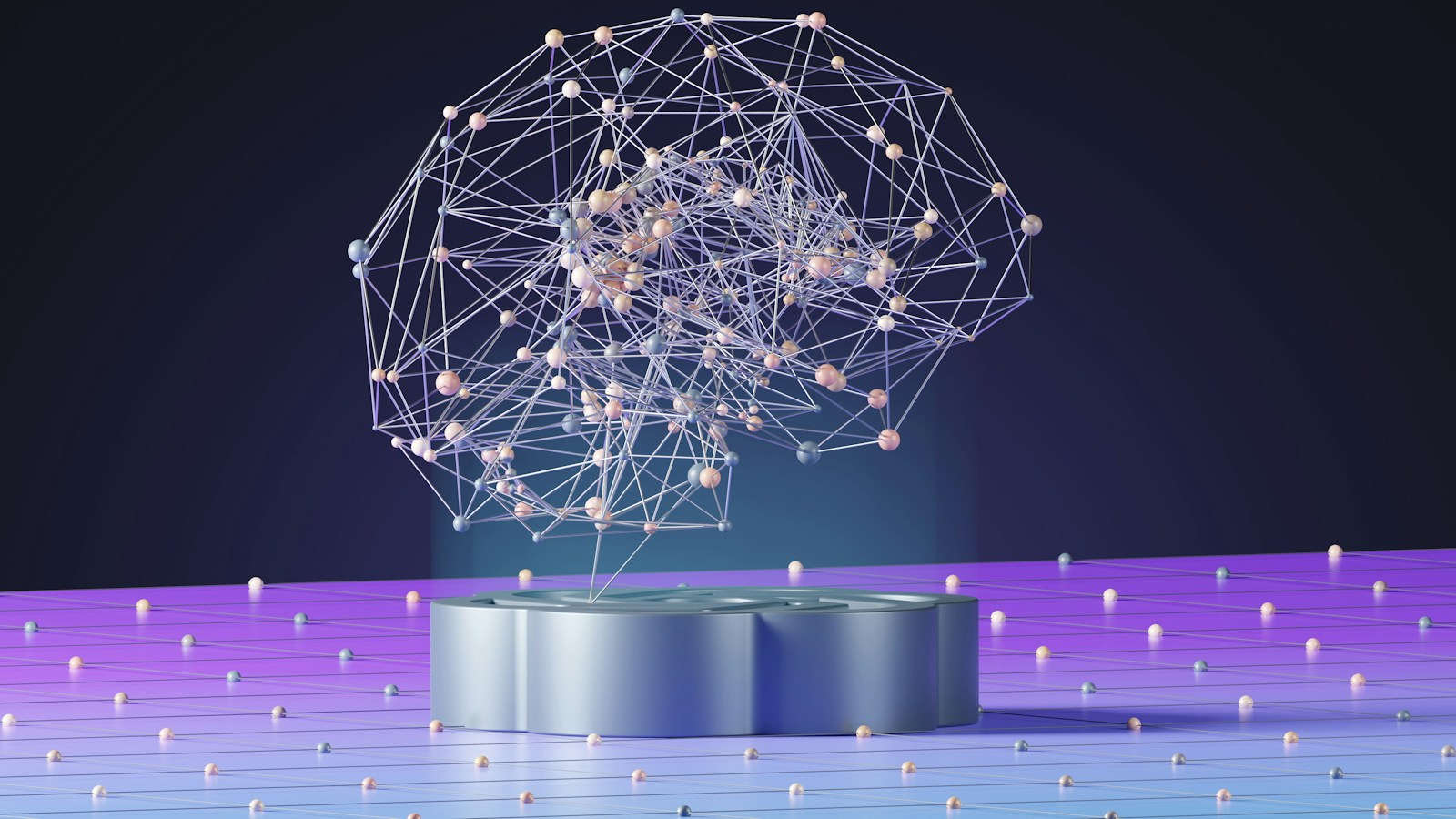
Featured image credit: Growtika via Unsplash. Image sourced through WPVibe/Unsplash and uploaded to WindsorCastle.info. Image alt text: Abstract artificial intelligence network representing computer prediction of possible futures.
SEO keywords: AI future prediction, artificial intelligence, future technology, time travel AI, computer simulation, AI forecasting, predicting the future, future simulation.